Nuremberg: the Christkindlesmarkt has its own currency
The Christkind opens the Christkindlesmarkt on 27 November at 5.30 pm. The market has its own coins, a separate children’s Christmas market and a long history: in 1678 it was first put on paper as ‘Kindles-Marck’.
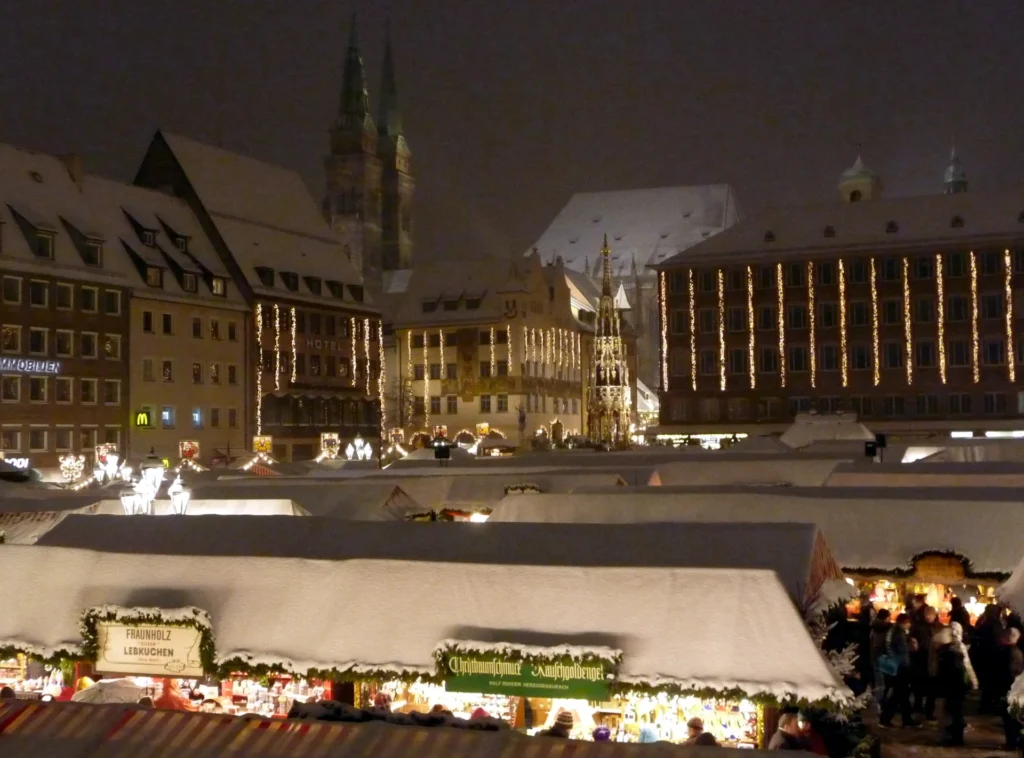
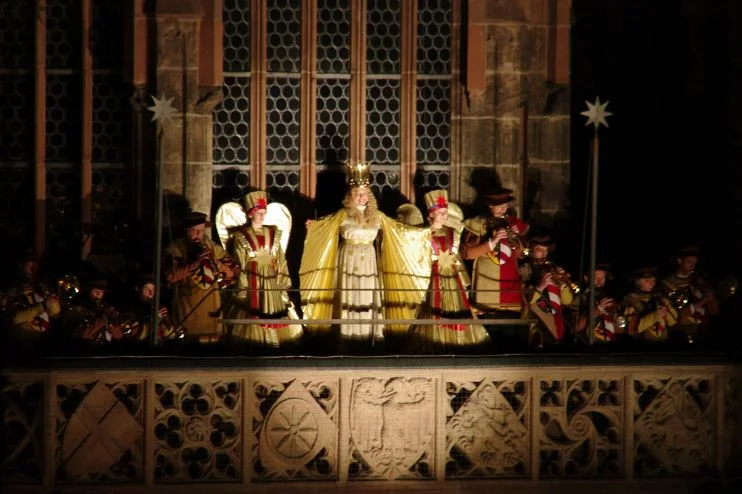
On Friday 27 November at 5.30 pm, the stalls on the Hauptmarkt in Nuremberg fall quiet. Trading pauses for half an hour for the ceremony in which the Christkind opens the Christkindlesmarkt. At 6 pm the stalls reopen, that evening until 10 pm. After that the market is open daily from 10 am to 9 pm, up to and including 24 December. On that last day it closes at 2 pm.
This year the Christkind is Nora Falk, a schoolgirl born in Nuremberg in 2009. A jury chose her for two years, 2025/26. The city has been choosing a Christkind since 1969. The first was Gabriele Bergmann. Candidates must, among other things, be at least 1.60 metres tall. The idea of the Christkind goes back to Martin Luther, who moved the giving of gifts to children to Christmas Eve, away from saints’ days. Nora Falk speaks the opening prologue.
The market itself is old. The city calls it one of the oldest Christmas markets in Germany. In 1678 it was first put in writing, as ‘Kindles-Marck’. In 2025 there were more than 160 stalls with red-and-white cloth roofs on the Hauptmarkt, the ‘Städtlein aus Holz und Tuch’, the little town of wood and cloth. In 2024 more than two million visitors came. The stalls sell Lebkuchen, fruit bread, sweets, toys, decorations, crafts, mulled wine and Nuremberg sausages, among other things.
The toys are traditional rather than modern. The organisers deliberately keep high-tech and war toys out of the stalls. The market also has its own money: the Christkindlesmarkt-Taler, worth 5 euros and an official means of payment. The coins go on sale from mid-November in one shop only, the Wöhrl branch on Ludwigsplatz. Ten cost 45 euros, for a value of 50 euros. Each person can buy at most a hundred, while stocks last. They can be redeemed in four places: the Hauptmarkt, the Markt der Partnerstädte on the Rathausplatz, the Kinderweihnacht on Hans-Sachs-Platz and the ‘Original Regional’ stalls in front of the Sebalduskirche.
Two separate sites lie around the main market. On the Rathausplatz the Markt der Partnerstädte runs from 27 November to 23 December, with stalls from cities including Glasgow, Verona, Nice and Atlanta. On Hans-Sachs-Platz the Kinderweihnacht runs from 27 November to 30 December, with a carousel, a steam train and a mini Ferris wheel. The Christkind visits there from Tuesday to Friday at 2.30 pm.
The first year after the Second World War with a market again was 1948. The Zwetschgenmännla, a typical souvenir of the market, appear in historic photographs from 1935.
Anyone coming by public transport gets off bus 36 at the Hauptmarkt. Buses 46 and 47 do not stop at Heilig-Geist-Spital this year because the Obstmarkt is being rebuilt. The replacement stop is on Tetzelgasse, level with house number 2.
Practical
Location: Hauptmarkt, Nuremberg
Christkindlesmarkt: 27 November to 24 December 2026
Open: daily 10 am-9 pm, on 24 December until 2 pm; on 27 November a pause from 5.30 to 6 pm and open until 10 pm
Markt der Partnerstädte (Rathausplatz): 27 November to 23 December
Kinderweihnacht (Hans-Sachs-Platz): 27 November to 30 December
Info: christkindlesmarkt.de