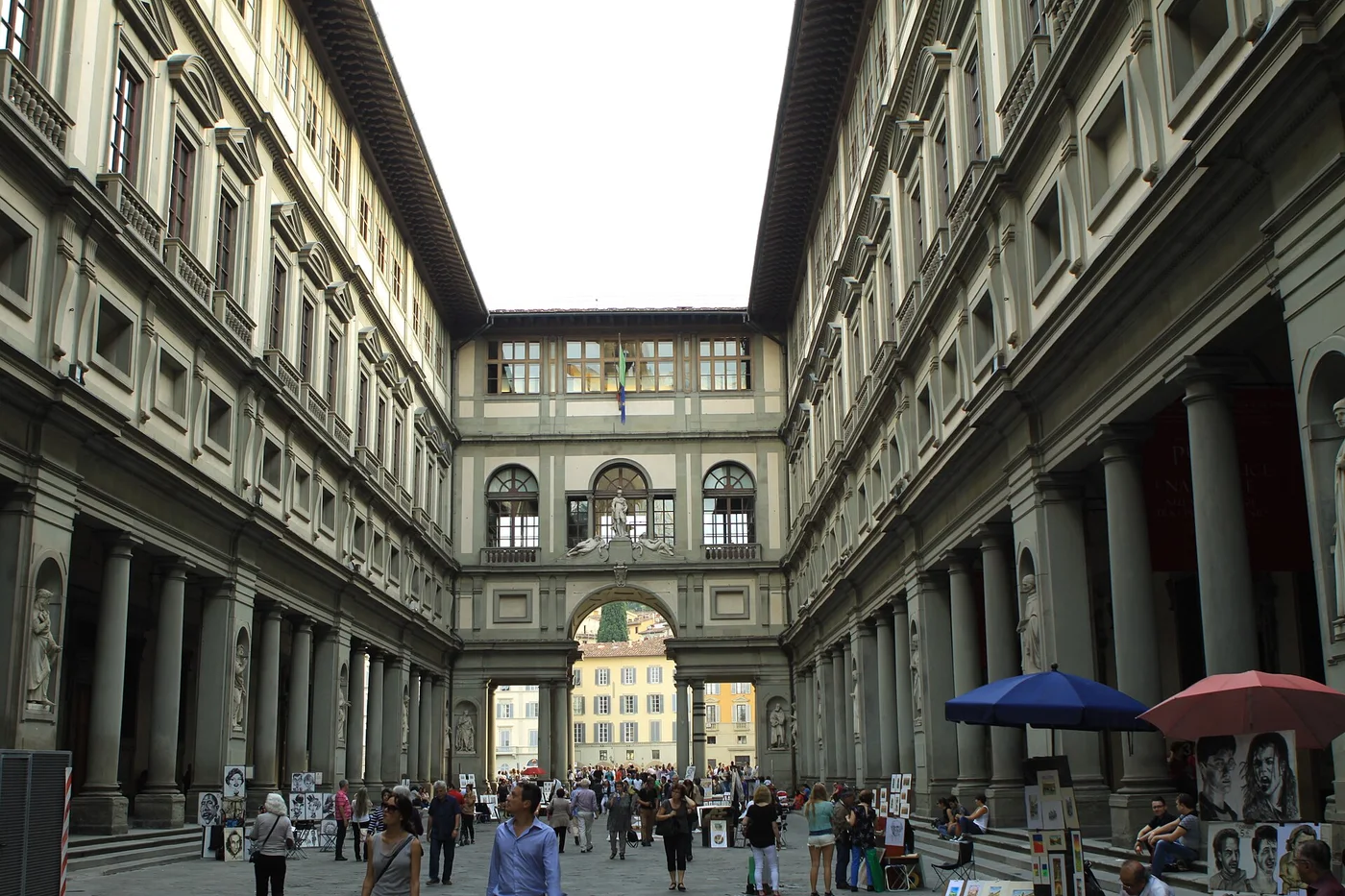
The Uffizi: an office building that took in the Renaissance
The name means offices, and that is no joke. Florence's most famous museum was built to put civil servants under one roof.
Uffizi means offices. Not gallery, not palace, not collection. Offices.
That is not a linguistic curiosity but a precise description of what the building was put up for.
Cosimo's administrative problem
Construction began in 1560, commissioned by Cosimo I de' Medici and directed by Giorgio Vasari. The task was political.
Florence had a republican past, and that past still lived on in its organisation: countless committees, offices and guilds, each with its own place in the city, its own archive and its own customary rights. Anyone wanting to govern such a city is hampered by that dispersal.
The solution was spatial. House them all in one building, and your grip on them tightens by itself. What sits together can be overseen.
For that purpose Vasari designed a long, narrow U around a courtyard that opens onto the Arno. Construction was continued by Alfonso Parigi and Bernardo Buontalenti and was completed around 1580.
How the top floor became something else
The building had a top floor, and it was given another purpose: a gallery for the family and their guests, with their collection of Roman sculpture.
That is the seed of everything that followed. Below, a state was governed; above, things were shown. The collection was private, meant for those who were admitted, and it hung in a corridor above the administration of a state.
That combination is rare and explains the museum's shape. The Uffizi does not have rooms like a museum built later; it has a corridor. You walk through it in one direction, because it is a passage that happened to acquire a collection.
From court collection to museum
It was opened to the public and formally became a museum in 1865. That is late compared with the Louvre, which took that step as early as 1793.
The difference says something about how such collections became public. In Paris it happened through a revolution: the king's property became the nation's property. In Florence it was more gradual, through access for visitors that slowly widened until the status was finally fixed.
What the building does to you
A museum that consists of a corridor imposes an order. You cannot wander as in a building with rooms opening onto one another; you go forward or you go back.
For a collection of Renaissance art that happens to be favourable. The works are largely arranged chronologically, and the architecture turns the visit into a line: you see painting develop as you walk, in the order in which it happened.
At the end of the corridor there is the view of the Arno. It was there when the building was still offices, and it is still the moment when it becomes clear: this is not a museum with windows onto the city, it is a piece of city in which a museum later settled.
Why that matters
Museums are usually described by what hangs in them. With the Uffizi, the building itself is half the story.
It was built to centralise government, and precisely that concentration made it suitable to house a collection later. An administrative measure from 1560 determined the order in which visitors see the Renaissance.