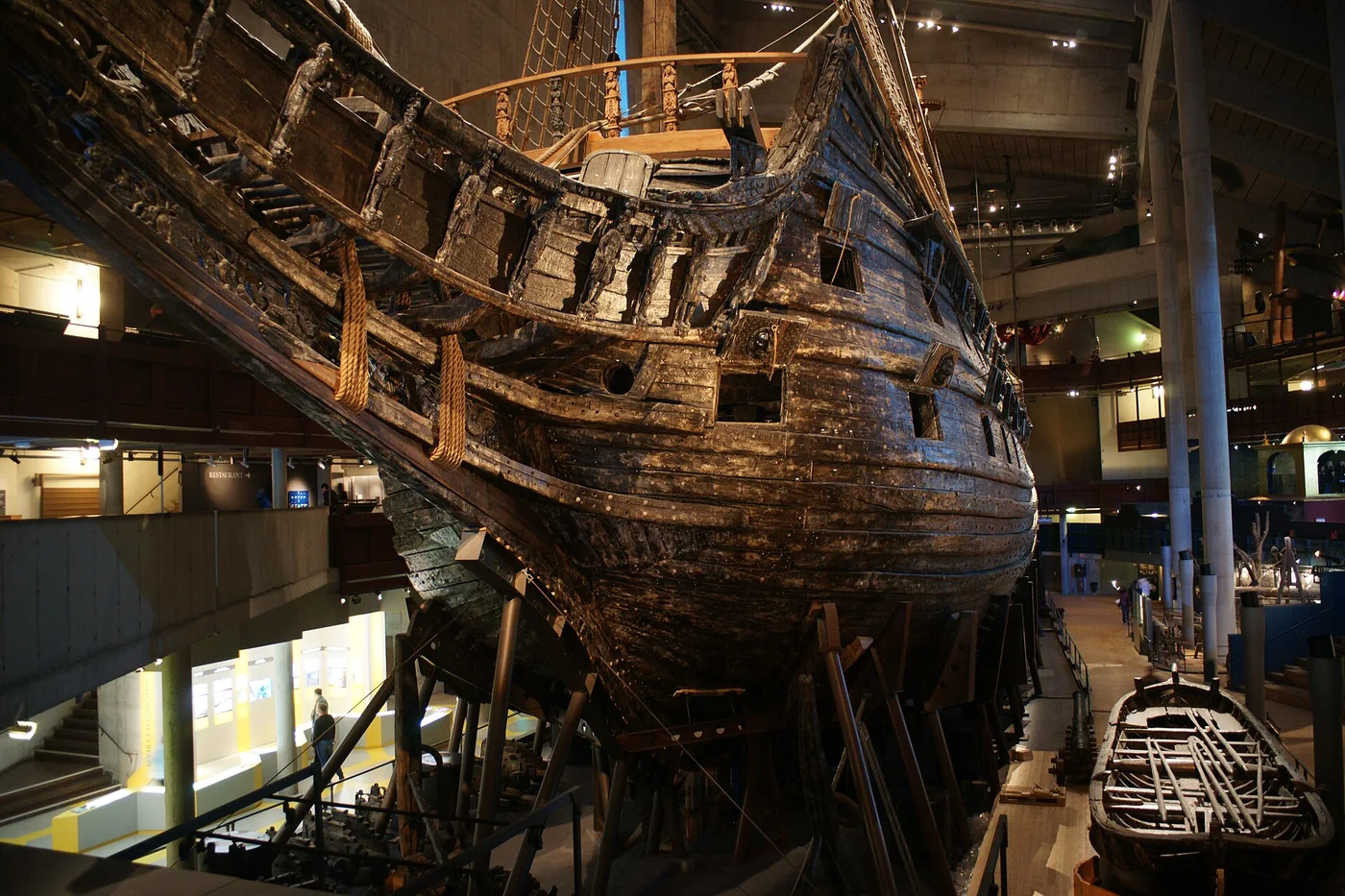
The Vasa: the ship that sank because nobody dared contradict the king
After thirteen hundred metres Sweden's flagship capsized within sight of the city. That she still stands today is because the Baltic is too fresh for the shipworm.
On 10 August 1628 the Vasa set out on her first voyage. She got about thirteen hundred metres. Then she capsized in Stockholm harbour, in front of a city that had come out to watch.
The ship had been built between 1626 and 1628 on the orders of King Gustavus Adolphus, as part of Sweden's military build-up. She was meant as a display of power: high-built, heavily armed, carved from end to end.
The fault was in the design, not the crew
The Vasa's weight distribution was wrong. The hull was too top-heavy, and that was not a detail anyone could correct on the way. Adding ballast did not help; the problem sat so deep in the design that only a major redesign could have fixed it.
The fact that seventeenth-century warships were deliberately given high superstructures, to serve as firing platforms, did not help either. And the safety margins of the age were far below anything that would be acceptable now. The Vasa was, in the sober phrasing of later analysis, a risky undertaking.
What the inquest brought out
After the disaster the Swedish Privy Council organised an inquiry. During those hearings the stability test carried out beforehand also came up.
The prosecutor put it to the shipwright Hein Jacobsson bluntly: why did you build the ship so narrow, so badly and without enough bottom that it capsized?
Jacobsson answered that he had built her as Henrik Hybertsson had directed him. Hybertsson, the original shipbuilder, had died shortly before. And Hybertsson had followed the specification approved by the king.
Jacobsson had in fact widened the ship himself, by one foot five inches, some forty-three centimetres. Not enough, but it shows he saw the problem.
This is where the story turns uncomfortable. The king's subordinates lacked the political courage to raise the ship's problems openly or to have the maiden voyage postponed. Everyone knew, nobody said. At the end of the inquiry no one was punished.
Why she is still here
Here the second half of the story begins, and it is about water.
In the early 1950s the amateur archaeologist Anders Franzen reasoned that wrecks in the Baltic stood a particular chance. That cold, brackish water is free of the shipworm Teredo navalis, the animal that in warmer, saltier seas consumes submerged wood rapidly.
Franzen had located wrecks before. For years he probed without result, until he found the Vasa, in a busy shipping area of Stockholm harbour. In 1961 the ship was salvaged with a largely intact hull, after three hundred and thirty-three years on the seabed.
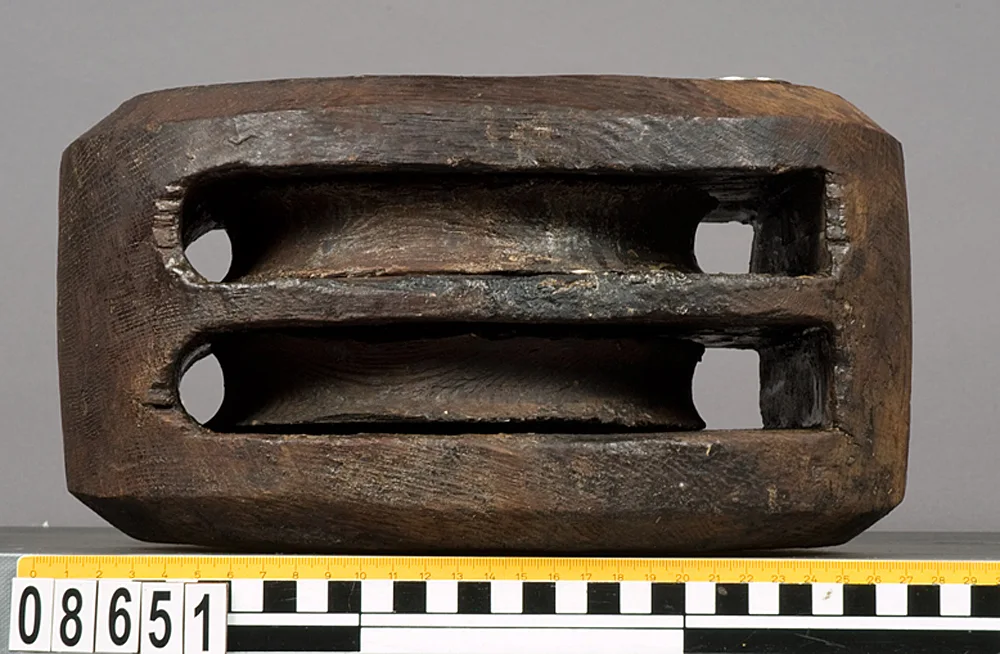
During that recovery marine archaeologists found thousands of artefacts, and the remains of at least fifteen people. The ship was not an empty stage set.
From shipyard to museum
The Vasa stood until 1988 in a temporary home called Wasavarvet, the Vasa Shipyard. She then moved permanently to the Vasa Museum in the Royal National City Park in Stockholm. Between the recovery and the start of 2025 more than forty-five million people have seen her.
The conservation is not finished. The museum states that the ship needs a new support structure to stop it settling again. A hull carried by water for three centuries now has to be held up by steel.
What you see on walking in is therefore two things at once: a failure from four centuries ago, and the reason that this particular failure is the one that survived. A thousand ships of that century have vanished. This one sailed too short a distance to sink far away, and sank into water that left the timber alone.