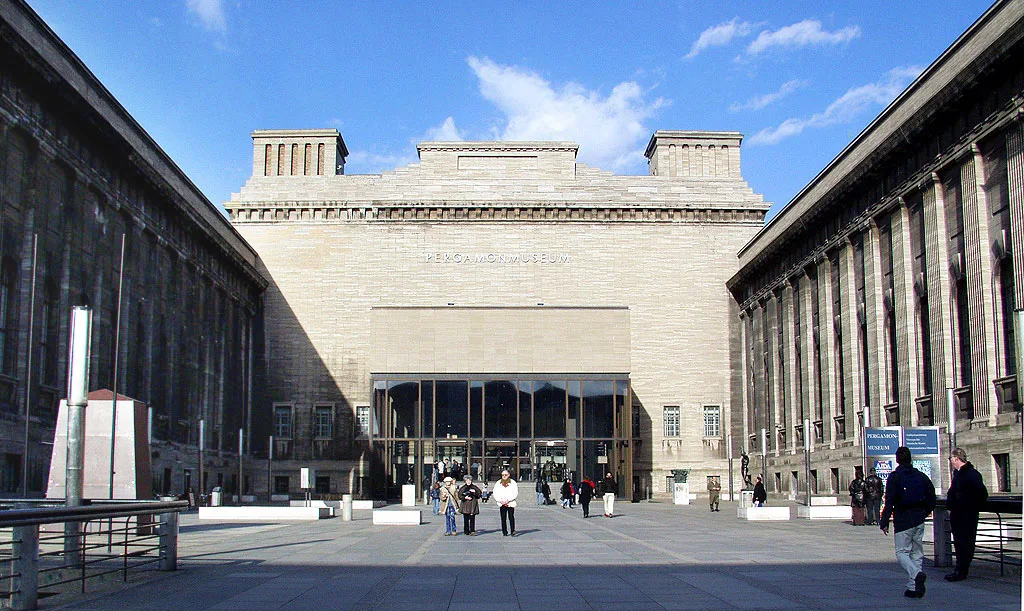
Museum Island: five museums on an island in the Spree
Berlin put its collections on an island in the river. That produced a unique ensemble and a problem that never goes away.
In the middle of Berlin the Spree divides and forms a long island. On its northern half five museums stand together, within walking distance.
That is rare. In most capitals the great collections are scattered across the city, having grown wherever space happened to be. Here they were put in one place, and that was a decision.
Why an island
The choice had practical and symbolic sides that reinforced each other.
Practically: an island is bounded. You know exactly how much space there is, and what you put on it stands together. For a nineteenth-century state wanting to order its collections, that was attractive.
Symbolically: by putting museums on a separate piece of ground, you make a district of them. You do not pass by chance; you go there. The island thereby became a gesture about the place of art and learning in the city.
The problem that arose at once
And there lies the drawback, which became clear early.
When the Kaiser-Friedrich-Museum opened in 1904, today's Bode Museum, it was already clear that more space was needed. An island does not grow.
That is the structural problem of this ensemble. Collections expand, museum standards change, climate control and accessibility demand space that did not have to exist in 1830. But the boundary of the site is fixed, because the river sets it.
What that means now
The consequences can be seen clearly at the moment. The Pergamon Museum has been completely closed since October 2023. The museum has announced that the north wing and the northern central section, including the Pergamon Altar, will return on 4 June 2027; the south wing is expected to remain closed until around 2037.
That is not an isolated case but the extreme example of a recurring pattern: on Museum Island something is almost always closed. Visitors rarely find all five museums open at once.
Partly that is due to deferred maintenance and to the city's history: war damage, division, and decades in which there was little money on the eastern side. Partly it is simply what happens when you put five large buildings in a fixed place and let them all age together.
What makes it special all the same
Despite that, or rather because of it, the island is worth the visit. You see not only collections but an idea: that you can order the world by laying it side by side.
The buildings date from different periods and were built in different styles, yet they stand within one plan. Walking from one to the next, you do in ten minutes what takes a day in other cities.
That maintaining that plan has become a project of decades is part of the bill. Building an ensemble is one decision; keeping it open is an obligation without an end date.