Guggenheim Bilbao: can a building save a city?
A port city in decline put up a museum and became a destination. Since then half of Europe has tried to copy it, usually without the result.
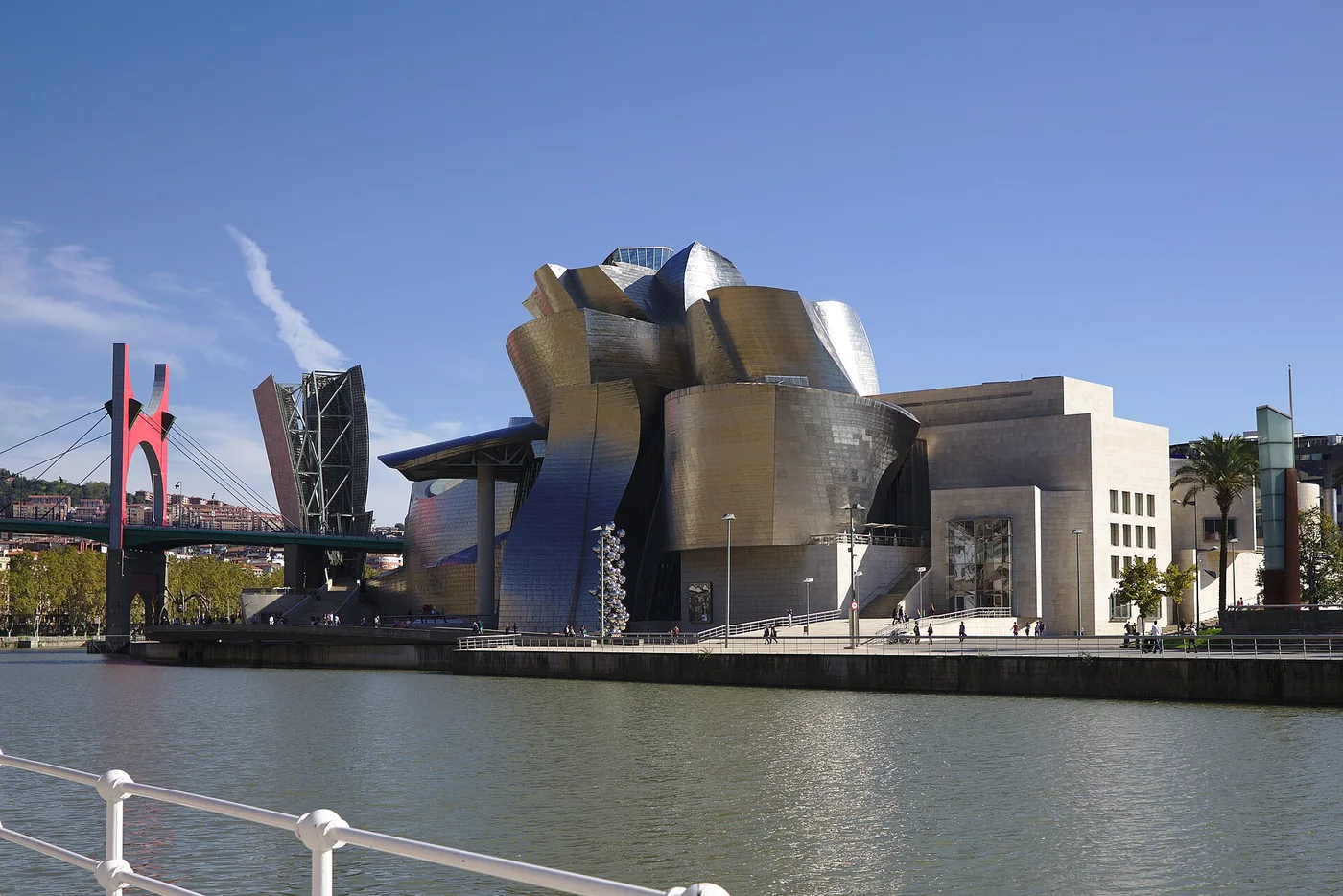
On 18 October 1997 a museum opened in Bilbao's Abando district that did not look like a museum. Curved surfaces, no straight facade, and a skin that looks different in every light.
The Solomon R. Guggenheim Foundation had chosen Frank Gehry as architect, and director Thomas Krens encouraged him to make something daring and innovative. That succeeded to a degree that rarely happens: the building became better known than what hangs inside it.
What the skin is made of
The museum is clad in glass, titanium and limestone. The titanium lies in thin sheets, like scales, on a galvanised steel structure.
That scale-like structure is why the building moves without moving. Each sheet catches the light slightly differently, and because Bilbao has a cloudy climate with much changing light, the colour of the facade changes all day long.
The glass is not just glass: it has been treated to prevent light from damaging the works on display. That is the invisible half of such a design. A building that seems to be all about form must meanwhile simply be a museum.
What it did for the city
Bilbao was an industrial and port city that was struggling. The museum became part of a broader plan to transform the city, and became its visible face.
The effect was so striking that a term was coined for it: the Bilbao effect, the idea that striking architecture can transform a city economically. In 2025 the museum drew over 1.3 million visitors.
Why that term is risky
A caveat belongs here that most accounts leave out.
Since Bilbao, countless cities have tried to do the same: a striking building by a famous architect, in the hope that the rest will follow. The result is usually a striking building.
What happened in Bilbao was not just a museum. It was part of a larger plan in which the port, public transport and the riverbanks were also tackled. The museum was the figurehead of that operation, not the operation itself.
Anyone who copies only the figurehead copies the visible part of a change that was largely invisible.
What can be transferred
There is still a useful lesson in it, and it is not about architecture but about sequence.
Bilbao decided that the city had to become somewhere people wanted to go, and then chose a building that could carry that. Not the other way round. The building is spectacular because the brief was allowed to be spectacular, and that brief came from a decision about the city.
That also explains why the museum works where it stands. It lies on the river, on a site that was industrial, and it curves with the bend of the water and with the bridge that runs past it. It is not an object set down somewhere; it is fastened to this place.
Almost thirty years later it still stands as proof of something only half understood: that a building can help tip a city, but only if the city itself was already tipping.