Red Vienna: how tax money made the housing courtyards possible
Behind the monumental municipal courtyards lies a fiscal choice. Vienna used tax money to build affordable homes, with a special role for the progressive housing construction tax.
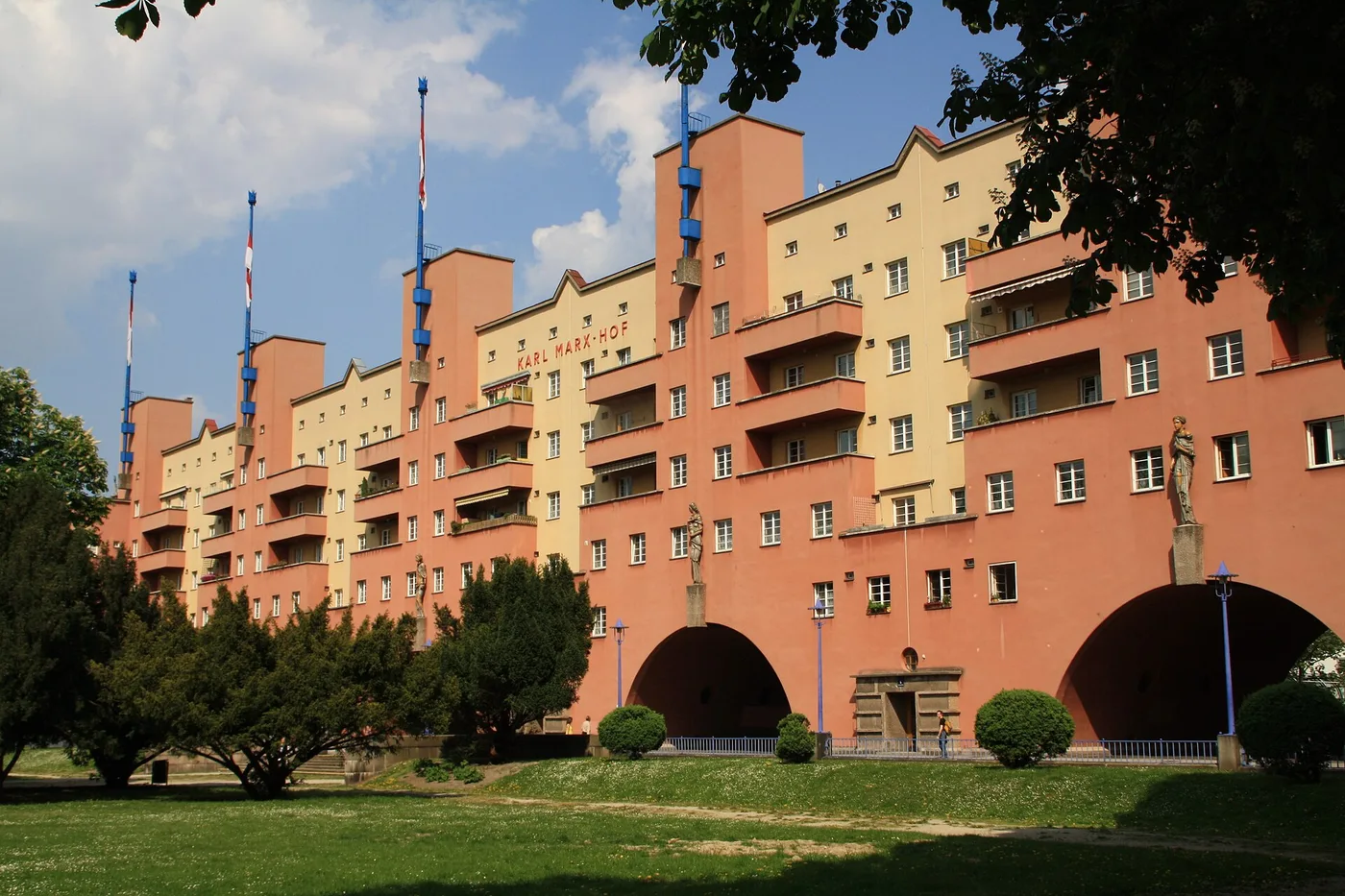
Walking through Vienna, you pass buildings that do not fit the ordinary cityscape. Long blocks with gateways opening onto inner courtyards, heavy facades, small towers, and above the entrance a year and a name.
These are the Gemeindebauten, the municipal courtyards, and they come from a short and exceptional period known as Red Vienna, when the Austrian Social Democrats governed the city.
Breitner's tax
The most interesting thing about these buildings is not their architecture but their bookkeeping.
In 1923 Vienna introduced the Wohnbausteuer: a steeply progressive housing construction tax, developed under finance councillor Hugo Breitner. It was an important source of funding for the municipal courtyards, alongside other municipal resources. So it was not a tax simply named after Breitner, nor solely a levy on luxury goods.
That financing choice matters. If construction is paid for with tax money, the rent does not have to bear the same financing burden as in a project paid for entirely with loans. The tax system thus helped make the homes affordable.
Why they look like fortresses
The municipal courtyards are strikingly monumental for social housing. Massive facades, symmetry, and gateways better suited to a public building than to a housing block.
That was a choice, not an accident. Anyone building homes for people who had until then lived in poor housing can do it in two ways: as cheaply as possible, or so that the building itself says something.
Vienna chose the second. The courtyards were built to be seen, with inner courts, laundries, bathhouses, nursery schools and libraries inside. A housing block became a public amenity.
Where gardens had previously lain on the site, the city council had them removed to make room. That too says something about the priority it was given.
The flip side of that form
That heavy, closed way of building later took on a meaning that was probably not foremost in anyone's mind at the time. A building with gates that can be shut and inner courts that cannot be seen from the street is defensible.
In the Austrian civil war of 1934 it was used that way, and the Karl-Marx-Hof came under fire. A housing block became a battleground, and that cannot be separated from how it was built.
Why it survived
The most striking thing is not that this happened, but that it held. The model of municipal housing was not dismantled in Vienna when the political period was over.
As a result the city has kept a housing stock that is not priced by the market, and that is why Vienna keeps standing out in comparisons of housing costs.
What can be learned from this therefore does not begin with the facades alone. Behind the monumental gateways there is also a budgetary choice: a city that uses tax revenue for housing. Architecture and financing tell the same story here.