Venice and the water: 78 gates against a city that will not move
Steel gates lie under the inlets of the lagoon, rising when the tide comes. They work. The question is what happens if they are needed more often than intended.
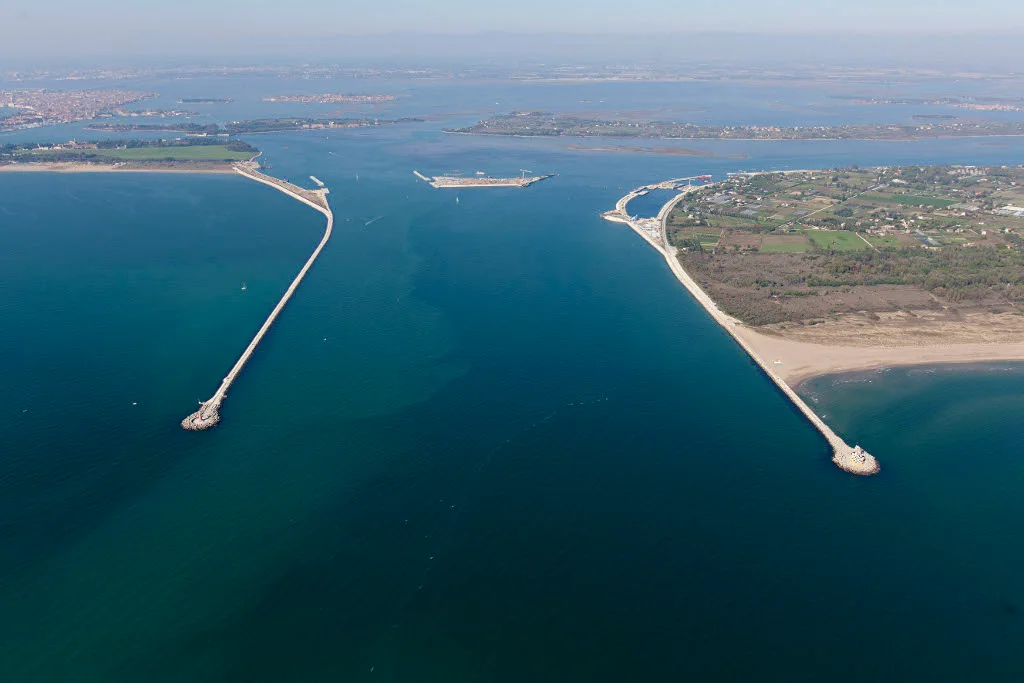
Venice does not flood because rain falls but because the sea comes in. The city sits in a lagoon connected to the Adriatic by three inlets: Lido, Malamocco and Chioggia. In certain combinations of tide and weather, more water is pushed in than can get out.
This is called acqua alta, high water, and it is nothing new. Floods are recorded in 1543, in 1550, in 1559 and in 1599, and the year 1600 had so many that chroniclers took the trouble to note them all.
How high is high
To talk about high water at all, you first have to agree where zero lies. In Venice that is the average sea level of the year 1897. Everything since has been measured against that mark.
Above that datum there are fixed thresholds. Between a hundred and ten and a hundred and thirty-nine centimetres the water is called very intense. From a hundred and forty centimetres it is termed exceptional.
Those figures are not weather talk but operations: evacuations, walkways and warnings hang on them.
The year that changed everything
In 1966 an acqua alta arrived that exceeded all the previous ones. Afterwards the city set up a dedicated service to analyse data, monitor the water level and forecast high tides, charged as well with keeping the population continuously informed. Since 1980 that service has been called the Tide Monitoring and Forecast Centre.
That is an underexposed part of the story. Before you can close off a lagoon, you have to be able to predict it. The gates now lying there would be unusable without that measuring work.
What lies on the seabed
The MOSE system consists of movable gates that lie flat on the seabed and are raised when high water threatens, temporarily sealing the lagoon from the sea.
There are seventy-eight of them, in four rows. At the Lido, the widest inlet, there are two rows of twenty-one and twenty gates, linked by an artificial island that also carries the technical buildings.
They come into operation above a hundred and ten centimetres. Below that the lagoon stays open and the city has to rely on other measures: coastal reinforcement, raising quaysides, and works in the shallow parts of the lagoon. Raising quaysides is no routine job in Venice and Chioggia, since it has to be done without destroying the architectural character of those quays.
The long road there
Construction began on 14 May 2003. The last gate was laid on 30 January 2019. On 10 July 2020 the first full test followed, and on 3 October of that year the system went into action for real, during a high tide.
So it has been demonstrated to work. That it came in on time and on budget, not at all. The original completion date of 2011 slipped to 2018, then to 2021, and in November 2025 the work still did not count as finished. Along the way there were cost overruns and scandals.
The question underneath
A movable barrier is a solution with an assumption built in: that you need it now and then. Every closure costs money, shuts the port and interrupts the exchange between lagoon and sea on which the whole ecosystem runs.
As long as high water is the exception, that is a good trade. If it becomes the rule, the calculation changes, and not only the financial one: a lagoon closed off from the sea too often eventually stops being a lagoon.
That is the tension Venice is now in. The city has built an impressive answer to the question of 1966. The question itself has changed since.