Reykjavik: a capital that runs on hot groundwater
Nine out of ten Icelandic homes are heated with water from the ground. That is not a natural wonder but a decision, taken when oil became too expensive.
In Reykjavik there is rarely snow lying on the pavement outside a shop in winter. Not because it is swept, but because there are pipes underneath carrying water that comes out of the ground.
It is the most everyday use of something that elsewhere would be called a power station. Iceland heats homes with it, and greenhouses, and swimming pools, and therefore pavements too.
The figure that carries the story
At least ninety per cent of all homes in Iceland are heated with geothermal energy. Not ninety per cent of new build, or of the capital, but of all homes.
That is a share no other country comes near, and it is not down to geology alone. There is a decision underneath it.
Why it happened when it did
The shift from coal and oil to geothermal district heating took place between 1930 and 1980. The decisive push came in the 1970s.
Oil prices were rising worldwide, and Iceland was in an awkward position: a small country, far away, entirely dependent on imported fuel to get through a winter that does not negotiate. The government responded by replacing oil with geothermal energy in district heating.
The result is measurable. The cost of heating fell sharply, and has since been much lower than in most other countries. What began as an emergency measure against a price shock became the most ordinary thing in the country.
This is the interesting part of the Icelandic story: it is usually told as luck, as though there is hot water under your house and you only have to open a tap. But the heat was just as present in 1950, and then people burned oil. The difference is an investment, a pipe network and a political choice at the right moment.
A bathing place that is a by-product
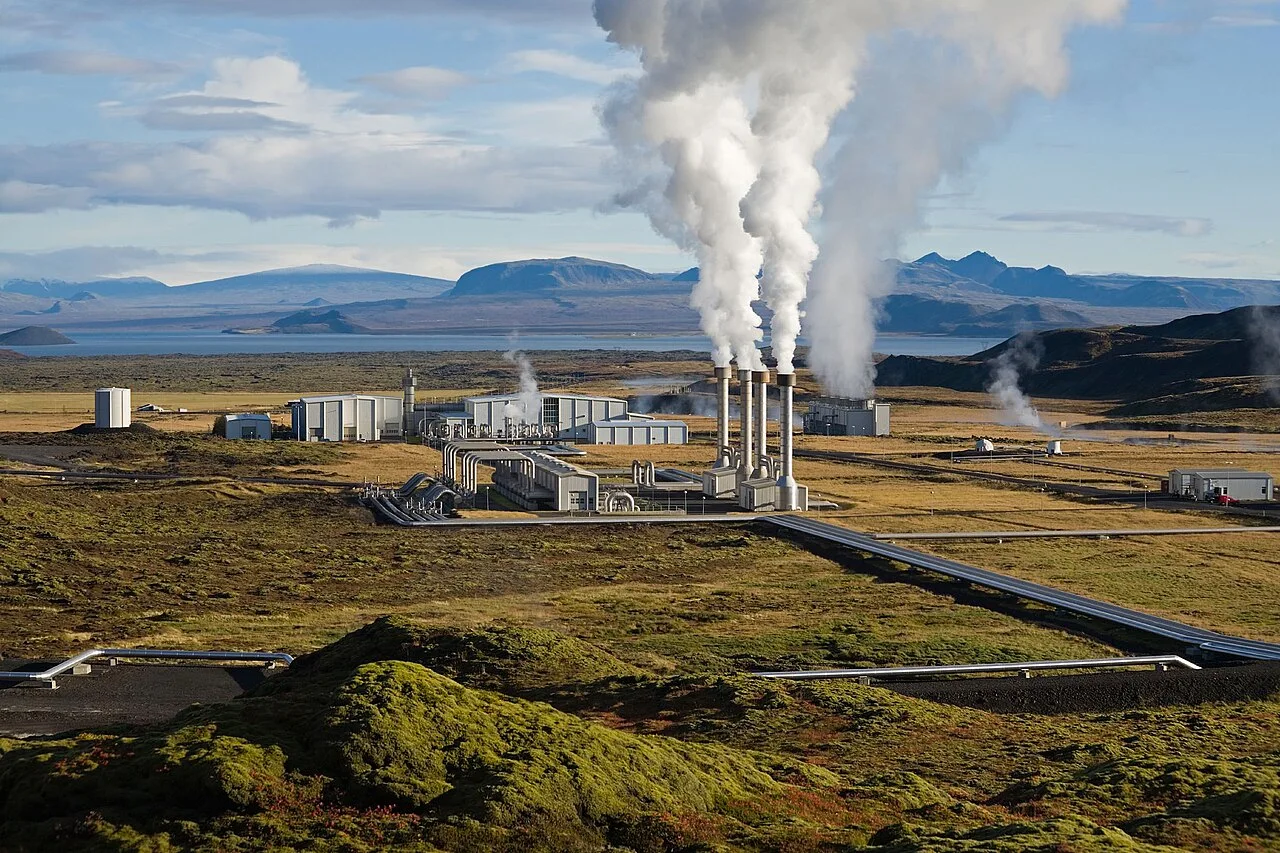
The best-known place where visitors come into contact with that heat is the Blue Lagoon. The water there is a mixture of seawater and discharged fresh water from the nearby Svartsengi power station.
So it is not a natural spring beside which a power station happens to have been built, but the reverse: a bathing place that arose at an energy plant. The blue, milky water belongs to the composition of what comes out of the installation.
What it does and does not mean elsewhere
The temptation is to conclude that other countries should do the same. That conclusion only half holds.
Iceland sits on the boundary between two moving plates and therefore has shallow, accessible heat in unusual quantities. That cannot be transplanted. What is transferable is the second half of the story: that a country can convert an entire heating supply within a few decades, if the price of the alternative rises high enough and the investment is once made.
For the visitor it is the small observation that stays. No plumes of smoke above the roofs, no oil tanks in the gardens, and in winter a pavement that stays dry by itself. The infrastructure of this country is largely invisible, and that is exactly why you notice it.