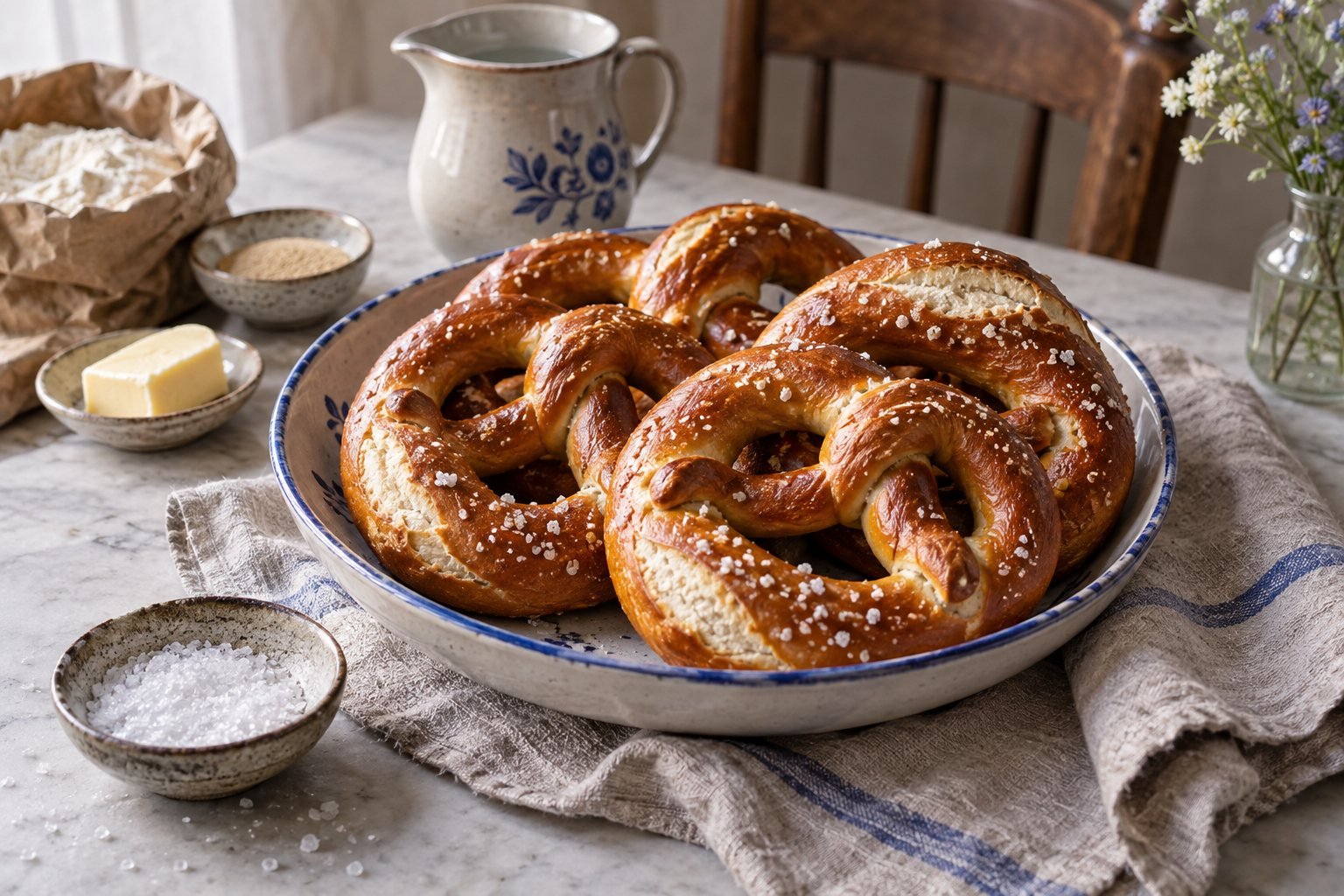
Brezel: why this bread takes a bath first
The brown, almost black sheen of a pretzel does not come from the oven but from a tub of liquid before it. Without that bath it is just a roll tied in a knot.
You recognise a pretzel by two things: the knot and the colour. The knot is design. The colour is chemistry, and it is decided before the bread goes into the oven.
The bath is the whole difference
Before baking, the twisted strands of dough go briefly through a bath. Traditionally that is a lye solution, nowadays sometimes soda.
That treatment gives the pretzel its characteristic crust and flavour. The surface becomes strongly alkaline, so the Maillard reaction in the oven proceeds much faster and further than with ordinary dough. Hence that deep brown, almost mahogany sheen you cannot get from baking alone.
Salt is the usual finish, and that is not arbitrary: the coarse salt complements the lye flavour. Other toppings exist too, from mustard and cheese to sugar, chocolate, cinnamon, glaze, seeds and nuts.
Why you should not use lye at home
Real sodium hydroxide works best, and that is exactly why it does not simply belong in a home kitchen. It is a caustic substance; bakeries handle it with gloves, goggles and fixed procedures.
For home use we use ordinary food-grade baking soda below. It gives a milder treatment and a less dark, glossy crust than lye. We do not bake the soda beforehand: that would actually make it more strongly alkaline.
What you should not do: make such a bath in an aluminium pan, or put the pretzels on aluminium foil. Alkaline solutions attack aluminium.
The shape
There are various stories about its origin, and almost all of them point to a Christian background and to European monks.
The best-known story has an Italian monk making the pastry in 610 as a reward to motivate his pupils in their studies. The twisted shape is said to represent crossed arms, as in prayer.
That is legend, not documented history, and it should be read as such. What the story does explain is why the shape is so constant. A bread roll can go a hundred ways; a pretzel has one shape and has kept it for centuries.
Why it is thick and thin at once
A well-twisted pretzel is thick in the middle and thin at the arms, and that is functional.
The thin parts become crisp and almost hollow; the thick belly stays soft and crumbly inside. One pastry thus holds two textures. That is exactly why the slit is cut into that thick belly: the steam has to escape there, otherwise it tears at a random spot.
Roll everything the same thickness and you get a knot of bread. Nice enough, but it is no longer a Brezel.
Make it yourself
Ingredients
- 500 g wheat flour
- 7 g dried yeast
- 10 g salt
- 280 ml lukewarm water
- 30 g soft butter
- 1 tsp sugar
- for the bath: 450 ml water and 56 g ordinary food-grade baking soda
- coarse salt for sprinkling
Method
- Dissolve the ordinary baking soda in the hot water and let the mixture cool to lukewarm or cooler. Pour it into a shallow dish that fits the pretzels in small batches.
- Knead the flour, yeast, salt, sugar, water and butter for eight minutes into a firm, smooth dough. It should be firmer than bread dough.
- Leave to rise for an hour. Divide into eight pieces and roll each into a strand of sixty centimetres, thick in the middle and thin at the ends.
- Twist the familiar knot: make a loop, twist the ends round each other once and press them onto the thick belly.
- Put the pretzels uncovered in the fridge for half an hour. A dry skin helps the crust.
- Lay the pretzels in the cooled bath for two minutes and spoon some liquid over the top. Lift them out of the bath with a slotted spoon and put them on the baking tray. Do not use an aluminium dish or aluminium foil.
- Cut a shallow slit into the thick belly, sprinkle with coarse salt and bake for twelve to fifteen minutes at 220 degrees until cooked through and golden brown. This home version stays lighter than a lye pretzel.
Allergens: gluten, milk. Gluten from the wheat flour and milk from the butter.
Use ordinary food-grade baking soda, not washing soda, baked soda or lye. Let the bath cool before the dough goes in.
Storage: Best on the day itself. The next day, warm briefly in the oven; do not store in a plastic bag, as the crust goes soft.