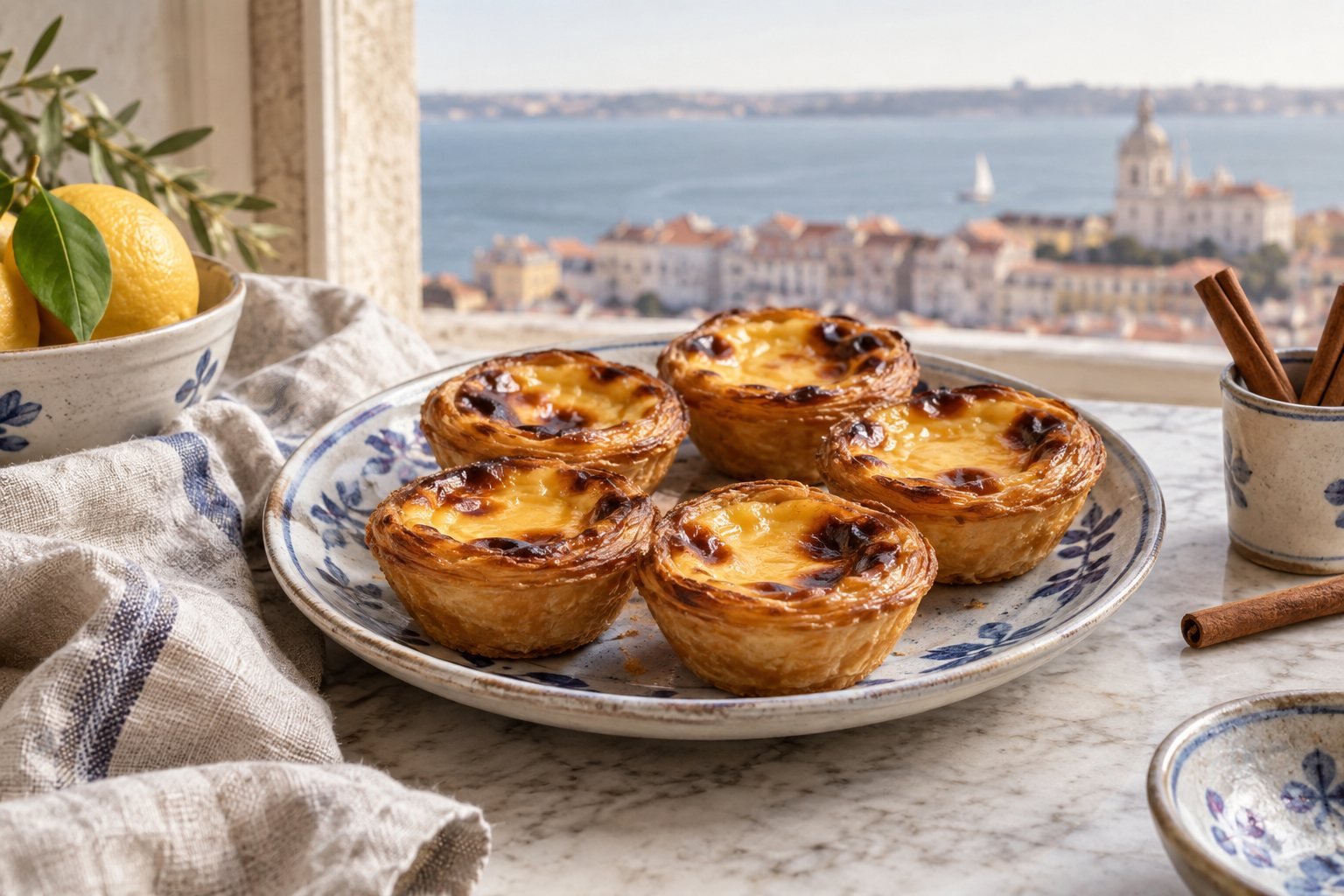
Pastel de nata: how a pastry from Belém became a world traveller
A small pastry with a big story. It has been sold in Belem since 1837; various stories circulate about its origins in the monastery.
The pastel de nata is a small puff-pastry cup with a custard filling that takes brown blisters in a fiercely hot oven. It is Portugal's best-known sweet, and it exists by way of a detour.
A monastery full of stories
According to a well-known origin story, monasteries used egg white to starch clothing and turned the leftover yolks into pastries. It is an appealing explanation, but not conclusive proof of how this one pastry came about.
The Portuguese heritage description calls the origin in the monastery of Belem a legend and also mentions another tradition, involving nuns from Odivelas. The stories belong to the pastry tradition; they do not establish who exactly invented it.
Firmer ground is offered by the history of the shop: in 1837 sales began in Belem. The company links its secret recipe to the nearby Jeronimos Monastery.
How a monastery recipe became a business
The monastery was closed in 1834. According to the company history, the sale of pastries then got going at a nearby sugar refinery.
In 1837 production of Pasteis de Belem began there. The company still keeps the recipe secret.
That is why Portuguese distinguishes two terms. Pastéis de Belém is the name of the original and of that one place. Pastel de nata is the name of everything based on it, which by now is half the world.
Why those black blisters belong
Anyone trying this at home usually runs into the same thing: the filling sets but stays pale, and the pastry goes soggy.
That is the oven temperature. These pastries need a very hot oven, so that the surface of the custard caramelises and blisters before the pastry has time to take up moisture. In a bakery that happens in ovens hotter than a domestic one can reach. At home the only remedy is: as high as the oven goes, and briefly.
Those dark patches are therefore not burning but proof that it went fast enough.
What does not belong in it
Cinnamon belongs with it but not in it. In Portugal cinnamon and icing sugar stand on the table, to be shaken over by hand. It does not belong in the mixture; the filling itself is milk, sugar, yolk and a little thickening, infused with a cinnamon stick and lemon peel that are then removed.
Whipped cream does not belong on top either, however often you meet it outside Portugal. Nata means cream, but it refers to the creaminess of the filling, not to a spoonful beside it.
Why they should be warm
A pastel de nata that has stood too long is a different pastry. The base draws moisture from the filling and loses its brittleness.
They are at their best within a few hours of baking, lukewarm, not cold from the fridge. That is also why in Lisbon they go over the counter singly rather than by the box of twenty: this is pastry with a shelf life measured in hours, in a country that has arranged its day around that.
Make it yourself
Ingredients
- 1 sheet of all-butter puff pastry, about 25 by 35 cm, or 250 g homemade puff pastry
- 500 ml whole milk
- 200 g granulated sugar
- 40 g cornflour
- 6 egg yolks
- 1 cinnamon stick
- 1 strip of lemon peel, without pith
- butter for the tin
Method
- Heat the oven as hot as it will go, at least 250 degrees. That is not an exaggeration but the whole point: the filling has to set and blister before the pastry goes soggy.
- Roll the puff pastry up tightly into a log and cut twelve slices of about two centimetres.
- Stand each slice upright in a buttered hole and push it out with a wet thumb into a little cup, up over the rim. You will see the layers as rings in the wall.
- Heat the milk with the cinnamon stick and lemon peel to just below the boil. Leave to infuse for ten minutes, then remove the cinnamon and peel.
- Mix the sugar and cornflour, stir in a splash of the warm milk to a smooth paste, and stir that back into the rest of the milk. Heat, stirring, until it thickens.
- Take off the heat, let it cool a little and whisk in the yolks. Strain the filling.
- Fill the pastry cups about three-quarters full. Bake for eight to twelve minutes, until the tops have dark spots. Those spots belong there.
- Let them cool briefly and eat them lukewarm. Cinnamon and icing sugar go over them at the table, not into the filling.
Allergens: gluten, egg, milk. Contains raw beaten yolks that cook through fully in the oven; bake until the filling has set and the top is spotted.
Storage: Best within a few hours. Covered in the fridge for up to two days; the pastry then loses its crispness.