Sachertorte: two houses, a lawsuit, and the question of how many layers
Vienna has two cakes that both claim to be the real one. The dispute dragged on for almost thirty years, and the ruling ended up finding for each of them on a different point.
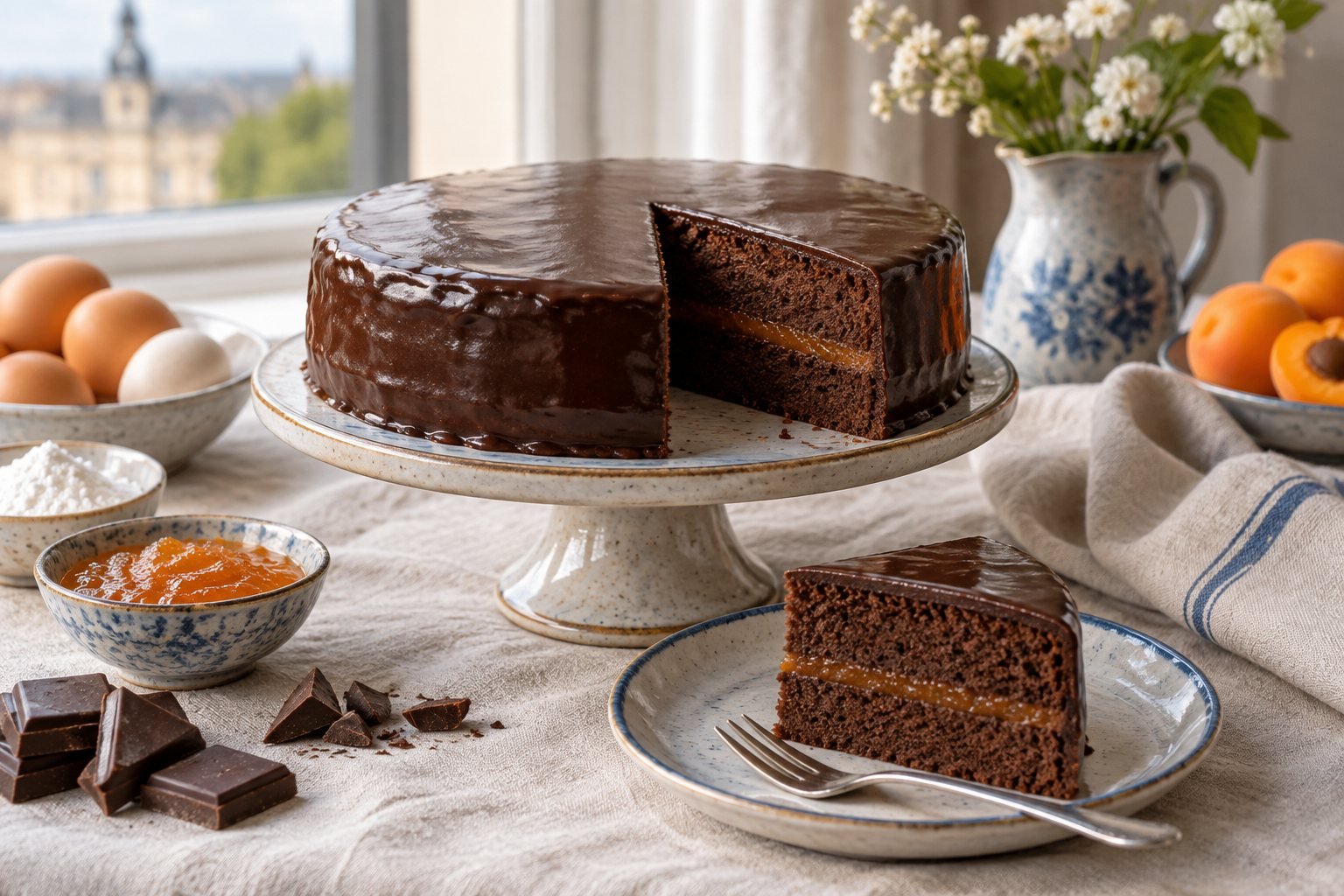
A Sachertorte is a chocolate sponge with apricot jam and a chocolate glaze. That is all it is, and that is precisely why it was fought over for almost thirty years.
The cake was invented by the Austrian confectioner Franz Sacher in the mid-nineteenth century. The best-known account has him making it in 1832 for Prince Metternich and his guests. Sacher was fifteen or sixteen at the time, in his second year of apprenticeship.
How firm is that story
Less firm than the telling suggests. The 1832 date rests mainly on statements made by Sacher's son Eduard in 1888: the cake had been made for Metternich, who enjoyed it. Later writers repeated it.
There is another timeline, and it comes from Franz Sacher himself. In a newspaper profile in 1906 he placed the creation in the 1840s, at the restaurant and catering business he ran in Pressburg. The same man, two accounts, almost seventy years apart.
The usual ornamental stories have grown around the invention as well. In one version the prince asked for a dry, masculine cake instead of the fluffy, feminine cakes then in fashion. In another, Sacher first consulted his sister. Charming, but it is tradition rather than record.
Where the quarrel started
Eduard opened Hotel Sacher in 1876, with the cake on the menu. That fixed the name to the hotel.
In 1934 the Demel pastry shop began selling its own version, with a single layer of sponge, under the name Eduard Sacher-Torte. At the hotel the two-layer cake continued to be sold as Original Sacher-Torte. That the word original sat in one name and the family name in the other was exactly the knot.
It complicated matters that Eduard had connections to both houses. He did not belong to one or the other; he had belonged to both.
In 1938 a lawsuit brought by one of the hotel's investors was settled in the hotel's favour. The war halted the dispute. Afterwards it returned, now before the Austrian Supreme Court, and now it concerned not only the name but also how many layers of sponge the original had: one, as Demel held, or two, as the hotel maintained.
The 1963 decision
In 1963 it ended. The court found for Hotel Sacher on ownership of the name, and for Demel on the number of layers.
That is a judgment of Solomon in cake form: the hotel may call itself the original, while the other side was found to be right about what the original actually was. Deutsche Welle, it should be said, reported that the matter was ultimately settled out of court.
Since then it has been settled in practice. Demel sells Demel's Sacher-Torte, the hotel sells Original Sacher-Torte. You can tell them apart by the chocolate seal on top: triangular at Demel, circular at the hotel.
What the law says
In Austria the name is protected by the food codex. It requires that a Sachertorte be made from a batter of butter, flour, eggs and sugar, with at least fifteen per cent chocolate by weight. Flavourings such as salt, vanilla and rum are permitted, and almonds, hazelnuts or walnuts too, provided the name reflects them.
What the codex does not regulate is the number of layers. That remained a matter for each house.
The reputation depends on where you are
The cake is judged strikingly differently from country to country. In Austria and Germany it stands high; the Austrian writer Franz Maier-Bruck calls it zart und mild, delicate and mild, and neither too soft, too sweet, too dry nor too gritty. For him a good Sachertorte comes from the balance of ingredients, the baking, and the smoothness of the glaze.
Elsewhere it sounds different. In the United States it is often thought dry and not sweet enough; in France, too sweet and short on chocolate. The British food writer Jane Grigson called it in the 1980s one of the most famous cakes in Europe, but not one of the best.
That contradiction may be the most attractive thing about the case. A cake two houses fought over for almost thirty years divides its eaters too. That it comes in Vienna with a spoonful of unsweetened whipped cream beside it is no accident: that cream is the counterweight the rest of the world is missing.
Make it yourself
Ingredients
- 130 g dark chocolate, at least 55 percent
- 150 g soft butter
- 120 g icing sugar
- 6 eggs, separated
- 100 g granulated sugar
- 150 g plain wheat flour
- pinch of salt
- 200 g apricot jam
- for the glaze: 200 g dark chocolate, 250 g sugar, 150 ml water
Method
- Preheat the oven to 170 degrees. Butter the tin and dust it with flour.
- Melt 130 g chocolate in a bain-marie and let it cool a little.
- Beat the butter with the icing sugar until fluffy. Stir in the egg yolks one at a time, then the melted chocolate.
- Whisk the egg whites with the salt until stiff, adding the granulated sugar in stages to a glossy mass.
- Fold the egg white and sifted flour alternately into the butter mixture. Do not stir, only fold.
- Bake for 50 to 60 minutes. A skewer in the centre should come out clean. Let cool completely.
- Cut the cake in half horizontally. Warm the jam, strain it, and spread it on the bottom half and then over the whole outside.
- For the glaze, boil the sugar and water to a syrup, take off the heat, stir in the melted chocolate and pour the glaze over the cake in one go. Let it set without putting it in the fridge.
Allergens: gluten, egg, milk. Check the chocolate for traces of nuts and soy.
Storage: Thanks to the high butter content the cake keeps well at room temperature. Store covered and eat within a few days.