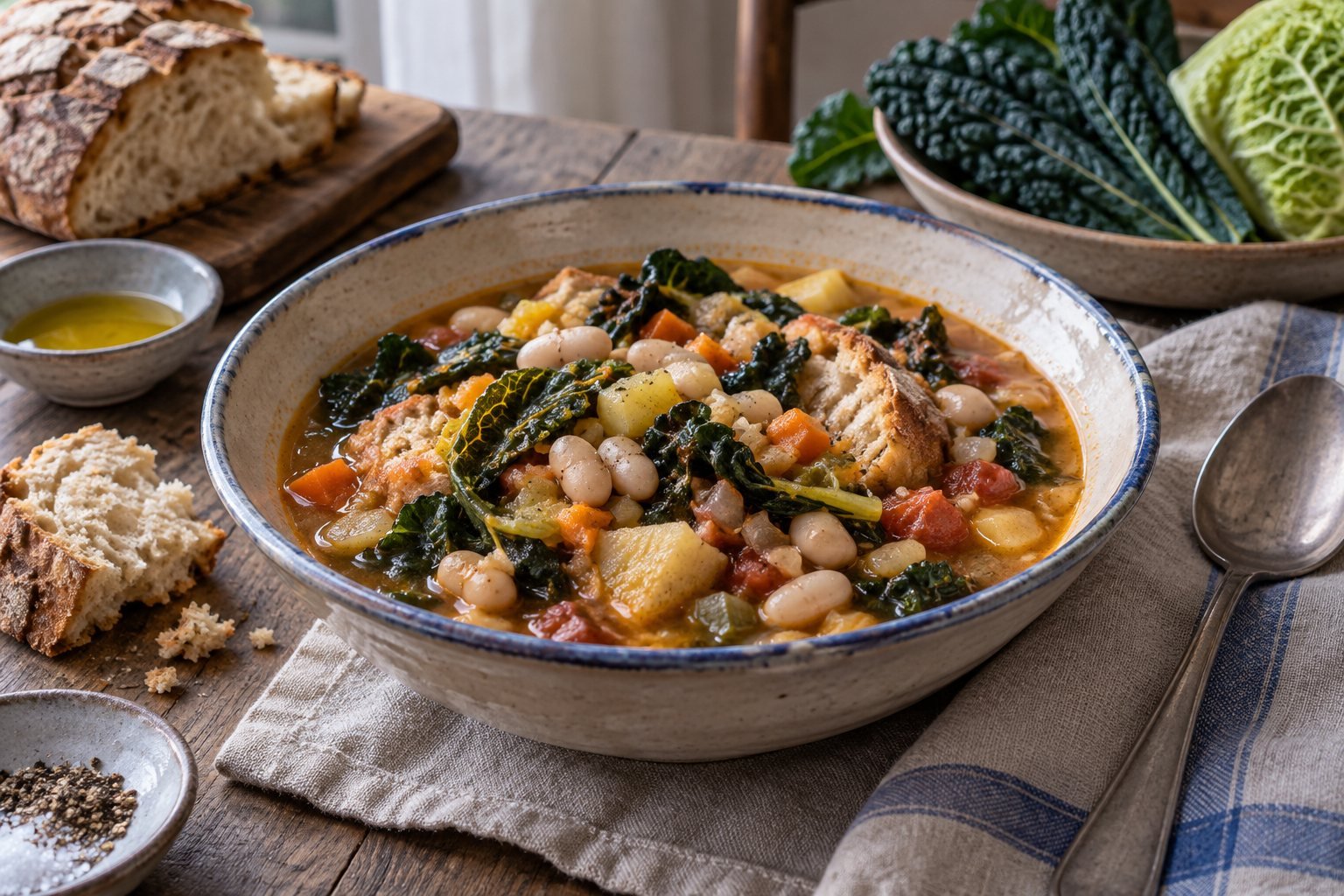
Ribollita: the soup that only starts on the second day
The name means reboiled. That is not a nickname but the method, and it explains why this dish belongs on a Friday.
Most dishes are finished when they come off the heat. With ribollita that is the moment the real work begins.
The name says it literally: reboiled. It is a Tuscan bread soup, made from bread and vegetables, and often from what was still standing.
How it came about
This is peasant food, like almost everything in Tuscan cooking. It was originally made by bringing large quantities of leftover minestrone or vegetable soup from the previous day back to the boil, together with stale bread.
That happened most often on Fridays, because it was eaten as a fasting food. The whole logic of the dish sits in that: no meat, no waste, and enough for a table.
So it is not that somebody invented ribollita and then started adding stale bread. It is the other way round. The bread was there, the soup was left over, and what came out proved better than either separately.
What belongs in it
Many variants exist, but the core is fixed: bread, cannellini beans, lacinato kale and cabbage, filled out with inexpensive vegetables. Carrot, beans, chard, celery, potato and onion, in varying combinations.
Lacinato kale is not a fashionable vegetable here but a winter necessity: in Tuscany it stands in the field into the frost and is improved by cold. A ribollita in July is possible, but this is a winter dish.
Often the pot finally goes into the oven, earthenware, so that a crust forms on top.
Why that second day matters
Make the dish in one day and you get a perfectly good vegetable soup with bread in it. The difference lies in what happens afterwards.
If, after being cooled quickly, the soup spends a night in the fridge, the bread falls apart completely and binds the soup from within. What was a liquid with pieces in it becomes a single mass in which you can stand a spoon upright. Only then is it ribollita.
That is also why the dish suits badly a restaurant cooking to order. It has to have waited.
A dish without a recipe
There is no authoritative version, and that is not a shortcoming. A dish that arose from using up leftovers has by definition no fixed ingredient list; what went in depended on what was left.
What is fixed is the technique: slow sweating, long simmering, bread stirred through, left to stand, reheated. Follow that order and you are making ribollita, even with other vegetables.
What it says about poverty cooking
Ribollita belongs to a category of dishes that arose from scarcity and now appear on the menus of restaurants where nobody eats out of scarcity. That is a familiar movement, and usually something is lost along the way.
Here the loss is limited, for a technical reason. The qualities that make the dish good, the time, the disintegrated bread, the thickness, are exactly the qualities that came out of poverty. You cannot refine it without wrecking it. A ribollita of fresh bread, quickly made and served at once, is not a more luxurious version but simply something else.
A pour of good olive oil, raw, just before serving is the only addition the dish tolerates. And that was probably always part of it.
Make it yourself
Ingredients
- 300 g stale, firm white country bread with little crumb, sliced
- 400 g dried cannellini beans, soaked, or 800 g cooked
- 1 large bunch of cavolo nero, about 400 g, stems removed
- 1/4 savoy cabbage, shredded
- 2 carrots, 2 celery sticks, 2 onions, all finely diced
- 2 potatoes, diced
- 2 tbsp tomato puree
- 3 cloves of garlic
- olive oil, salt, pepper
- 1.5 litres water or light vegetable stock
Method
- Cook the soaked beans until tender in plenty of water. Puree a third of them with some cooking liquid; that will be the thickener.
- Gently fry the onion, carrot, celery and garlic in olive oil until soft without colouring. Allow fifteen minutes for this.
- Stir in the tomato puree and fry briefly.
- Add the cabbages, potato, whole beans, pureed beans and the liquid. Simmer gently for at least an hour.
- Break the bread into pieces and stir it into the soup. Let it fall apart completely; that can take another half hour.
- Divide the soup between shallow containers, cool it quickly and put it, covered, in the fridge within two hours. Let it rest there overnight.
- The next day, reheat, if you like in the oven in an earthenware pot until a crust forms. Serve with a drizzle of raw olive oil.
Allergens: gluten, celery. Gluten from the bread and celery from the celery sticks. Also check the ingredients of the stock.
Storage: Put in the fridge within two hours and eat within two days. Reheat each portion until steaming hot throughout before eating.