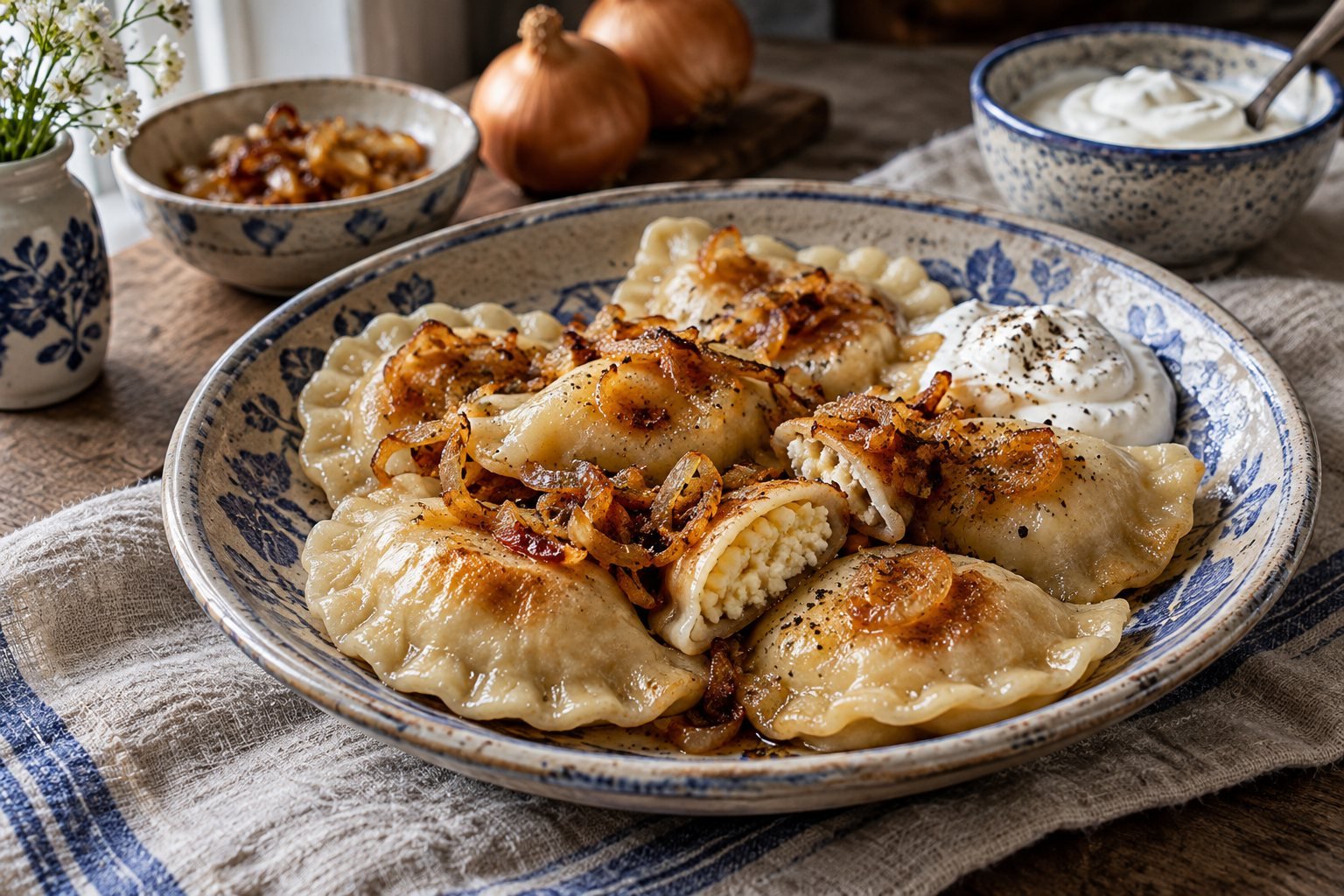
Pierogi: the word comes from feast, not from poverty
Filled dumplings are thought of as plain fare. The name says otherwise, and the Christmas Eve table bears it out.
Pierogi are boiled filled dumplings from Poland, and abroad they have a reputation as solid and simple. That picture is only half right.
What the word says
Pierogi is the plural of pierog, the general word for a single filled dumpling. And that word goes back to a Proto-Slavic root meaning feast.
That is a clue you do not expect for something you can eat every day. It explains why pierogi in Poland are so clearly tied to occasions, and why there are traditional Christmas Eve pierogi: a kind of their own for one particular evening.
Something named after a feast did not originate as filler for lean days. It originated as something that took work, for when there was reason for it.
The varieties that really matter
There are many, but three savoury ones keep coming back.
Pierogi ruskie are the best known: filled with twarog, a fresh curd cheese, together with potato and onion. The name refers not to Russia but to a historical region, something regularly misunderstood outside Poland.
Then there are pierogi z miesem, with meat, and pierogi z kapusta i grzybami, with cabbage and mushrooms. The latter are the classic meat-free fasting version, without meat, and for that very reason belong to Christmas Eve.
And then there are the sweet ones: with sweet curd cheese or with fruit, usually strawberries or blueberries, often served with cream. That the same form can be both main course and dessert is not strange once you see it as a wrapping rather than a dish.
Why they burst
When making them, things almost always go wrong at one point: the edge.
Filling that reaches the edge, flour where the dough has to stick, or wet hands, and the dumpling opens in the boiling water. Then you are boiling filling instead of pierogi.
The remedy is unspectacular. Little filling, a clean dry edge, and firm pressing. If in doubt, go over the edge again with a fork.
The second day is a dish of its own
Yesterday's boiled pierogi are not reheated in Poland but fried, in butter, until golden and crisp.
That is not a makeshift solution but, for many people, the favourite form. The dish therefore has two guises: soft and boiled on the day itself, crisp and fried afterwards.
Where else they went
Pierogi are also simply part of contemporary Canadian and American cooking, having travelled with Polish migration and become naturalised there.
That is the familiar pattern of emigrant cooking: the dish stays, the occasion disappears. What belongs to an evening in Poland sits in the freezer elsewhere. Meanwhile the word goes on saying where it comes from, even when no one hears it any more.
Make it yourself
Ingredients
- for the dough: 400 g plain wheat flour, 1 egg, 200 ml lukewarm water, 1 tbsp oil, pinch of salt
- for the ruskie filling: 400 g floury potatoes, boiled and mashed; 250 g twarog or quark; 2 onions, finely chopped and fried golden; salt and plenty of pepper
- to serve: butter, fried onion rings, sour cream
Method
- Knead the flour, egg, water, oil and salt into a supple dough. Cover and leave to rest for thirty minutes; otherwise it keeps shrinking back as you roll it.
- For the filling, mix the mashed potato with the twarog and fried onion. Season well; a bland filling is the most common mistake.
- Roll the dough out thinly, about two millimetres. Cut out rounds of eight centimetres.
- Put a teaspoon of filling on each round, fold in half and press the edge firmly shut. Work with dry hands and a dry edge, or they will open in the water.
- Cook them in plenty of lightly salted water. They are done once they float, plus about two minutes.
- Lift them out and let them drain briefly. Then, if you like, fry them in butter until golden; that is the usual second step for the previous day's pierogi.
- Serve with butter, fried onion and sour cream.
Allergens: gluten, egg, milk. Gluten and egg in the dough, milk in the twarog and the butter. The meat filling adds nothing to this list.
Storage: Cooked pierogi keep for two days in the fridge and can then be fried in butter. Raw, they freeze well on a tray, then loose in a bag.