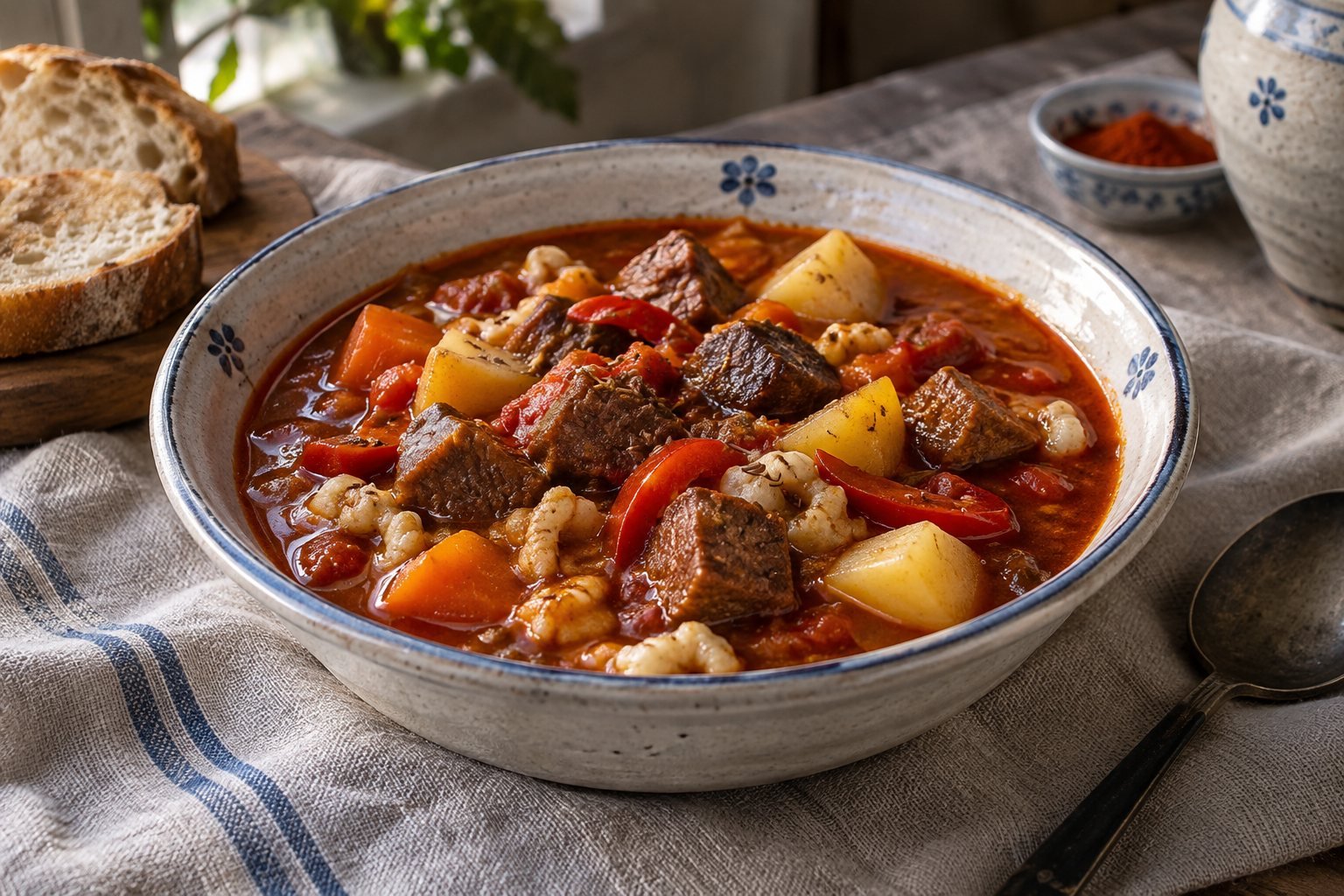
Gulyas: the word means cattle herder, not stew
Outside Hungary goulash is a thick stew in paprika sauce. In Hungary it is soup, and the name is not about the food but about who made it.
Ask for goulash in Budapest and you get a soup. A real soup, with broth you spoon, in which pieces of meat and vegetable float. What is called goulash in the Netherlands, Germany or Austria, a thick stew in dark red sauce, is a different dish there with a different name.
That difference is not a matter of cooking it wrong. It sits in the word itself.
What gulyas means
Gulyás means cattle herder, cowherd. It is an occupation, not a dish.
What the herders made was called gulyáshús, literally goulash meat: the meat dish of the cattle herders. Over time that second half wore away, and the name of the man passed to his food. Today gulyás refers to both: to the herders and to the soup or stew.
The Puszta as a larder
That herders had a dish of their own is not folklore in Hungary but economics. From the Middle Ages until well into the nineteenth century the Puszta, the great plain, was home to enormous herds of cattle.
Those animals were driven off in their tens of thousands, to Europe's largest cattle markets. That is not a day's journey. Anyone on the road for weeks with a herd has to cook on the way, outdoors, with what there is, over a fire.
That is where the form of the dish comes from: one pot, long and low, and plenty of liquid. A cauldron over a fire is not a sauté pan.
Why so much goes into it
In medieval times Hungarian herdsmen used every possible part of the animal, as was common practice everywhere. Meat was scarce, so nearly all of the beast went into the soup.
That also explains why gulyás traditionally calls for no noble cut. The dish is built on tough parts that need time, and on the idea that nothing is left over. Putting steak in it today does not make it better, only shorter.
The mistake with the paprika
There is one action on which the dish stands or falls, and almost everyone outside Hungary gets it wrong.
Paprika powder must not go into a scorching pan. It burns in seconds and turns irreparably bitter. In Hungarian cooking the pan therefore comes off the heat before the paprika goes in, and liquid follows immediately.
That is also why the dish could only take its present form late: paprika reached Hungary by way of the Balkans and became the characteristic ingredient only in time. The herdsman's pot is older than its best-known seasoning.
Where the confusion comes from
What is called goulash elsewhere is closer to what Hungarians call pörkölt: a stew with plenty of onion and paprika and little liquid. Both dishes come from the same kitchen and share a base, but the distinction between soup and stew is sharp there.
There is no judgment in this. A good Hungarian stew is a good Hungarian stew. But if you order in Budapest the dish you know from home, do not ask for gulyás.
The pleasing part is that the misunderstanding is a trace of history. The dish travelled with the herds, across the border, and changed shape on the way while keeping its name. Exactly like the name itself, which once denoted a man and now denotes a meal.
Make it yourself
Ingredients
- 800 g beef shin or chuck in 3 cm cubes
- 3 large onions, finely chopped
- 3 tbsp sweet Hungarian paprika
- 1 tsp caraway seeds, crushed
- 2 peppers, in strips
- 2 tomatoes, diced
- 3 potatoes in chunks
- 2 carrots, 1 piece of parsnip
- lard or oil, salt
- 2 litres water
- optional: csipetke, a small dough of 100 g flour and 1 egg, pinched into little pieces
Method
- Cook the onion slowly in lard until golden and sweet. This takes fifteen to twenty minutes and is the basis of everything.
- Take the pan OFF the heat and only then stir in the paprika. Paprika burns in seconds at high heat and turns bitter; this is the classic mistake.
- Immediately add a splash of water, then the meat, caraway and salt. Braise over low heat until the meat is almost tender, one and a half to two hours.
- Add the rest of the water, then the pepper, tomato, carrot and parsnip. Cook for twenty minutes.
- Add the potato and cook until everything is tender.
- If you want csipetke: knead the flour and egg into a firm dough, pinch off small pieces and cook them in the soup for the last ten minutes.
- Taste and season. The soup should be thin enough to spoon, with pieces you can recognise.
Allergens: none of the fourteen regulated allergens in the basic recipe. The basic recipe contains none of the fourteen regulated allergens. If you add csipetke, gluten and egg are added; if you use stock cubes, watch for celery and gluten.
Storage: Cool within two hours. Two to three days in the fridge; the flavour improves the next day. Reheat until piping hot throughout.