Lisbon 1755: the disaster that invented earthquake engineering
On All Saints' Day a capital collapsed three times over: first the shaking, then the wave, then the fire. What was devised afterwards is still standing.
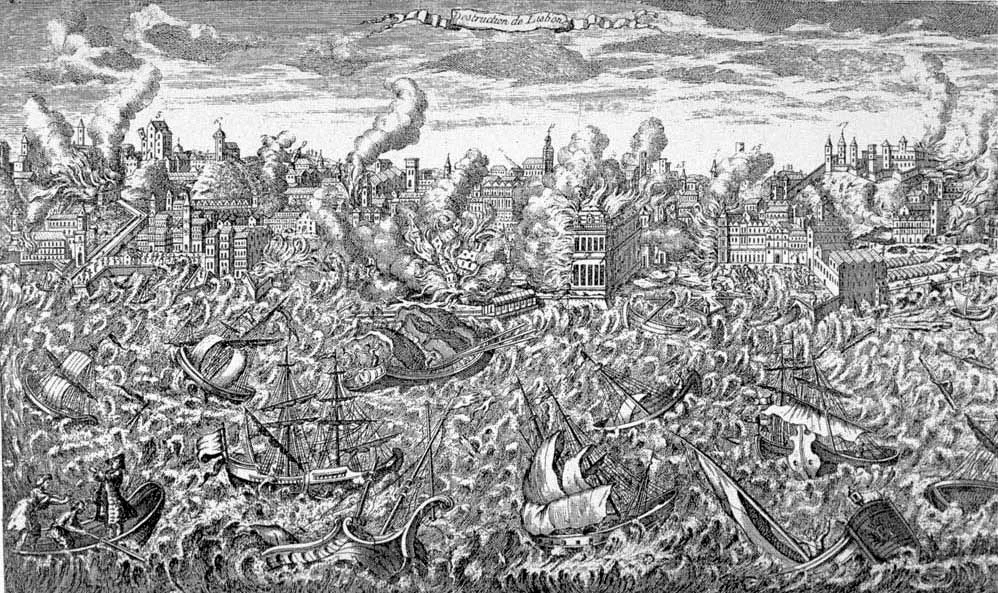
On Saturday 1 November 1755, All Saints' Day, at around 9:20 a.m. in the morning, the ground under Lisbon began to move. Contemporary accounts speak of three and a half to six minutes. Fissures five metres wide opened in the city.
The epicentre was not under the city but in the Atlantic, roughly two hundred kilometres west-south-west of Cape St Vincent. Its magnitude has been estimated after the fact and estimates vary; the US Geological Survey puts it at a moment magnitude of 8.5 to 9.0.
Three disasters in a row
Those who survived the shaking fled to the open ground by the river. It was the logical choice and it proved the wrong one: about forty minutes later the water came. The tsunami drained the harbour and then struck the quays. The same wave was noticeable as far as southern England and Ireland.
What the shaking and the water had left standing was taken by fire. On All Saints' Day candles were burning in every church; they ended up in the rubble. The fires raged for days.
Estimates vary, but in Lisbon probably between thirty and forty thousand people died, and in Morocco perhaps ten thousand more. It was not the first time the city had been badly hit; 1356 and 1531 had gone wrong too.
Bury the dead and heal the living
The prime minister, later the Marquis of Pombal, survived. Asked what should be done, he reportedly answered: bury the dead and heal the living.
That is not a fine phrase invented afterwards but a work programme. Firefighters were put on the blazes and teams assembled to remove the thousands of bodies before disease could spread. Contrary to custom and against the wishes of the Church, many of the dead were loaded onto barges and buried at sea.
At the same time order was kept with a hard hand. At least thirty-four looters were hanged, and King Joseph I had gallows erected in several parts of the city as a warning.
The questionnaire that started a science
Pombal's most remarkable decision cost nothing and changed the most. He sent a questionnaire to every parish in the country.
The questions were sober and precise. At what time did the earthquake begin and how long did it last? Did the shock seem greater from one direction than another, say from north to south? Did buildings fall more to one side than the other? How many people died?
This made it the first earthquake studied scientifically for its effects across a large area. Out of those answers came modern seismology, and earthquake engineering with it. Someone had asked not why it happened but how it had travelled.
That the inquiry was aimed well became clear centuries later. A 1992 seismic reflection survey of the ocean floor, along the Azores–Gibraltar fault zone, revealed a fifty-kilometre-long thrust fault south-west of Cape St Vincent. Possibly where it began.
A city that shakes but does not fall
The rebuilding of the Baixa, the low-lying centre that had been hit hardest, followed a new structural principle. The ground there is unstable, so reinforcing individual houses made little sense; the whole area had to be treated as one.
A flexible wooden frame was built into the walls, floors and roofs, and then clad with prefabricated components. The idea is deliberately not that the building should be stiff and strong, but that it should give. Shaking is allowed; falling is not.
Lisbon thereby invented two things at once: early anti-seismic construction and early prefabrication. The uniform streets of the Baixa you walk through today are not an aesthetic choice but the consequence of building in series, two centuries before that became normal.
And philosophy shifted with it
The disaster struck not only a city but a conviction. That on a church feast day, in one of the most devout cities in Europe, the churches fell on the faithful was hard to reconcile with the idea of a world watched over by a benevolent hand.
Voltaire used Lisbon in his Poème sur le désastre de Lisbonne and in Candide, which attacks the notion that all is for the best in this, the best of all possible worlds. The earthquake gave him his counterexample.
So Lisbon stands at the beginning of two things one rarely mentions in the same breath: the building codes a modern office block must satisfy, and the moment Europe began replacing the question of why a disaster happens with the question of how.