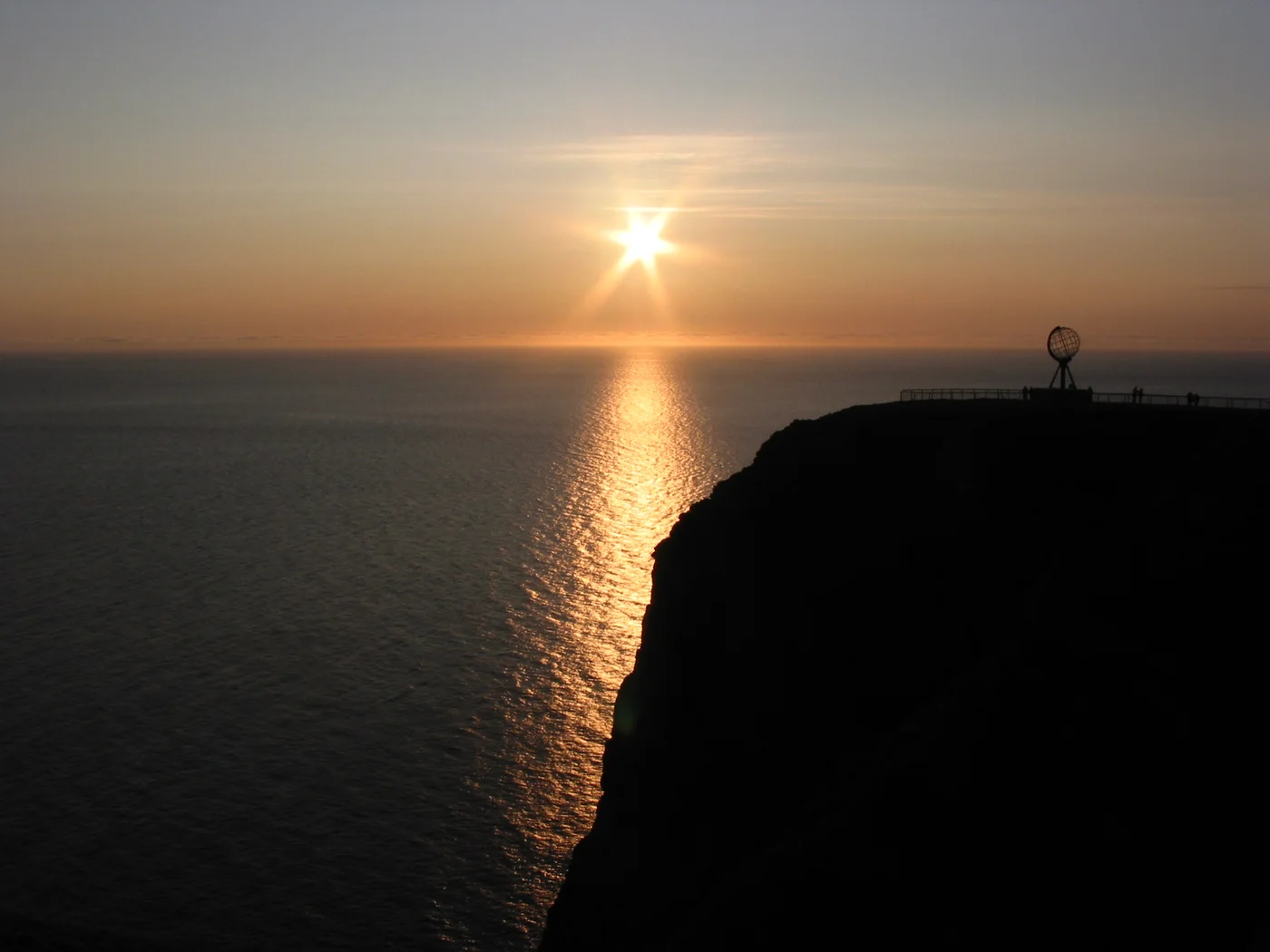
Midnight sun: why the sun does not set for weeks
Above the polar circle the sun stays up for months in summer and stays away for months in winter. The cause is a tilt of twenty-three degrees.
The midnight sun is exactly what the word says: the sun is still in the sky at midnight. Not as twilight, but visible above the horizon.
The phenomenon occurs in the summer months, north of the Arctic Circle and south of the Antarctic Circle, at latitudes from roughly sixty-five degrees forty-four minutes to exactly ninety degrees.
The cause is a single number
The Earth's axis is tilted with respect to the plane in which the Earth orbits the sun. That tilt amounts to twenty-three degrees, twenty-six minutes and just over twenty-one seconds.
Without that tilt there would be no seasons anywhere in the world, the day would last about twelve hours everywhere, and this whole phenomenon would not exist.
What the tilt does is turn the northern hemisphere towards the sun for half a year and away from it for the other half. At temperate latitudes you notice that as longer and shorter days. Near the pole it becomes absolute: there a point on Earth turns for a full day without ever reaching the shadowed side.
Why the polar circle lies where it does
The polar circle is not an arbitrary line and not a convention. It lies exactly where this happens for the first time.
On the circle itself it occurs one day a year: around the summer solstice the sun stays above the horizon for a single full day. Go further north and there are more. At the pole itself it lasts half a year.
That means the length of the polar summer can be read directly from your latitude. The further north, the longer the sun remains.
The other side comes with it
Whoever wants the midnight sun gets the polar night as well. They are not two phenomena but two sides of one.
In winter the sun does not rise above the horizon for the same period. That is the polar night, and it lasts as long as the summer stretch in which the sun did not set, at the same place.
This is often imagined as complete darkness, and that is not quite right. The sun is below the horizon but not always far below; there is prolonged twilight, blue and bright enough to walk by. Only close to the pole does it become truly dark.
What it does to a place
For those who live there this is not a sight but a way of dividing the year. It means the word day loses its usual function: you cannot tell from the light whether it is time to sleep.
That is why houses in northern Norway have blackout curtains that would count as excessive in the Netherlands, and why the difference between June and December there is not a matter of temperature but of an entirely different rhythm.
The pleasing part is that the whole phenomenon rests on one physical fact you can never see. The tilted axis is not observable; only what it causes.