The foehn: the wind that gets warmer by crossing a mountain
In the Alps the temperature can climb fourteen degrees in a few hours without the sun doing a thing. The explanation lies not in the air that arrives, but in what that air left behind on the way.
There are days in Innsbruck when winter stops halfway through the morning. The air turns dry, the mountains come unnaturally close, and the thermometer climbs while nothing in the sky seems to change. That is foehn.
A foehn is a dry, relatively warm downslope wind on the lee side of a mountain range: the side the wind tumbles down after crossing. In the Alps it usually arrives with moist air pushed over the range from the Mediterranean.
What happens on the way
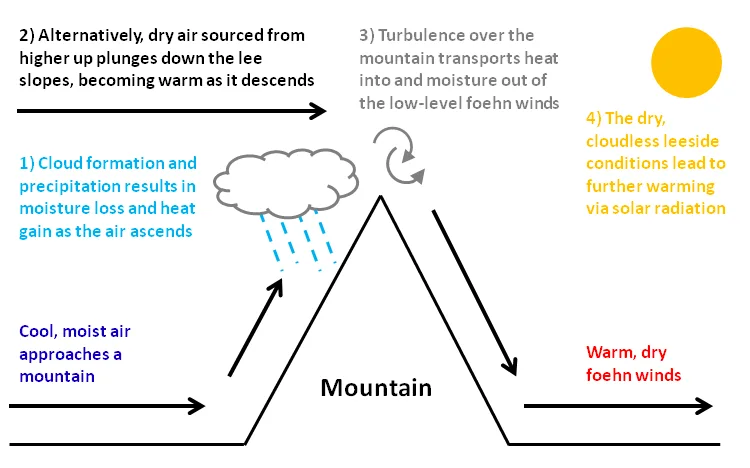
On the windward side the air has to climb. Rising air cools, and cold air holds less water vapour. So it rains there. The air loses most of its moisture on the slope it has to climb.
On the other side that same air descends again. Descending air warms. So far nothing is unusual: up is colder, down is warmer, and that holds everywhere.
The remarkable part is a difference you cannot see. Moist air cools more slowly as it rises than dry air warms as it sinks. Those two rates are not equal. The result is that the air arrives on the leeward side warmer than it was at the same altitude on the windward side. The mountain has not merely moved the air, it has changed it.
Fourteen degrees in a few hours
That difference is no theoretical nicety. A foehn can raise the temperature by as much as fourteen degrees in a matter of hours. Anyone who leaves the house in gloves in the morning is carrying them in a pocket by the afternoon.
It counts on the scale of a climate too. Switzerland, southern Germany and Austria are milder than you would expect at that altitude and latitude, partly because of the foehn. It is not an incident but a structural contribution.
The difference with the mistral
A foehn and a mistral are both winds that travel from high ground to low, and they feel like opposites. The mistral, which blows out of southern France into the Gulf of Lion, also descends, but it does not warm appreciably on the way down. It stays cold.
The difference lies in the history. A foehn gave up its moisture on the windward side and collects, on the way down, the heat that was released in doing so. The mistral comes down as a cold mass without that story. Two downslope winds, two coats.
The cloud that stands still
Foehn can be seen before it is felt. A taut, elongated bank of cloud often hangs along the ridge and does not appear to move with the wind. In the Alps that wall is called the foehn wall.
The cloud is not standing still, even though it looks that way. Air flows through it continuously: on the windward side moisture condenses and the cloud grows, on the lee side it dissolves again in the descending, warming air. What you are seeing is not an object but a balance. The same phenomenon occurs outside the Alps, for instance above the Cumbre Nueva on La Palma, where foehn clouds dissolve at around fourteen hundred metres.
A name that travelled with the wind
The word foehn comes from Latin: ventus favonius, a mild west wind, with Favonius as its Roman personification. By way of Romansh, where it became favuogn or simply fuogn, it entered Old High German as phonno.
That a Roman name for a gentle west wind stuck to an Alpine downslope wind says something about how people name weather: not after where it comes from, but after what it does to you.