Bergen: why a city is wet two hundred days a year
Europe's rainiest city owes that to seven mountains and a sea in front of them. The mechanism is the same one that makes the foehn on the other side of such mountains.
Bergen lies on the Byfjorden, enclosed by mountains, and owes its nickname to them: the city of seven mountains. The same setting determines the weather.
On average the city has around two hundred days a year with more than a millimetre of precipitation. There have been periods of more than two months in a row of rainy days. That makes Bergen the rainiest city in Europe, although it is not the wettest place on the continent.
What happens
The cause is called orographic lift, and it is one of the simplest mechanisms in meteorology.
Moist air comes ashore from the Atlantic Ocean. It runs into a mountain ridge and cannot go round it, so it has to rise. Rising air cools, and cold air can hold less water vapour than warm air. Whatever is too much condenses.
The result is precipitation on the side the wind blows against, and precisely there: on the first slope the air meets. Bergen lies on that slope.
The same mechanism, a different outcome
This is where it gets interesting for anyone who knows the foehn. It is the same physics with the opposite result.
Orographic lift produces four phenomena that belong together: precipitation on the windward side, a rain shadow on the lee side, downslope winds coming off the mountain, and the cloud formation that goes with it. Often a cloud stays sitting over the summit.
Bergen is on the wet end of that list. The foehn in the Alps, and the dry valleys behind every mountain range, are on the other end. The water that falls in Bergen is the water the air has to shed before it can go on.
The surprise: it is not cold
What people do not realise about Bergen is that it is remarkably mild for its latitude. The city lies at just over sixty degrees north, about as far north as southern Greenland and Anchorage.
Yet the weather is much milder than that position suggests. That is due to the same ocean that brings the rain: in winter the sea is warmer than the land, and the air coming over it carries that warmth along.
Rain and mildness are therefore not two separate qualities. They are one package. A winter without Atlantic air would be drier in Bergen and much colder.
What that means for the city
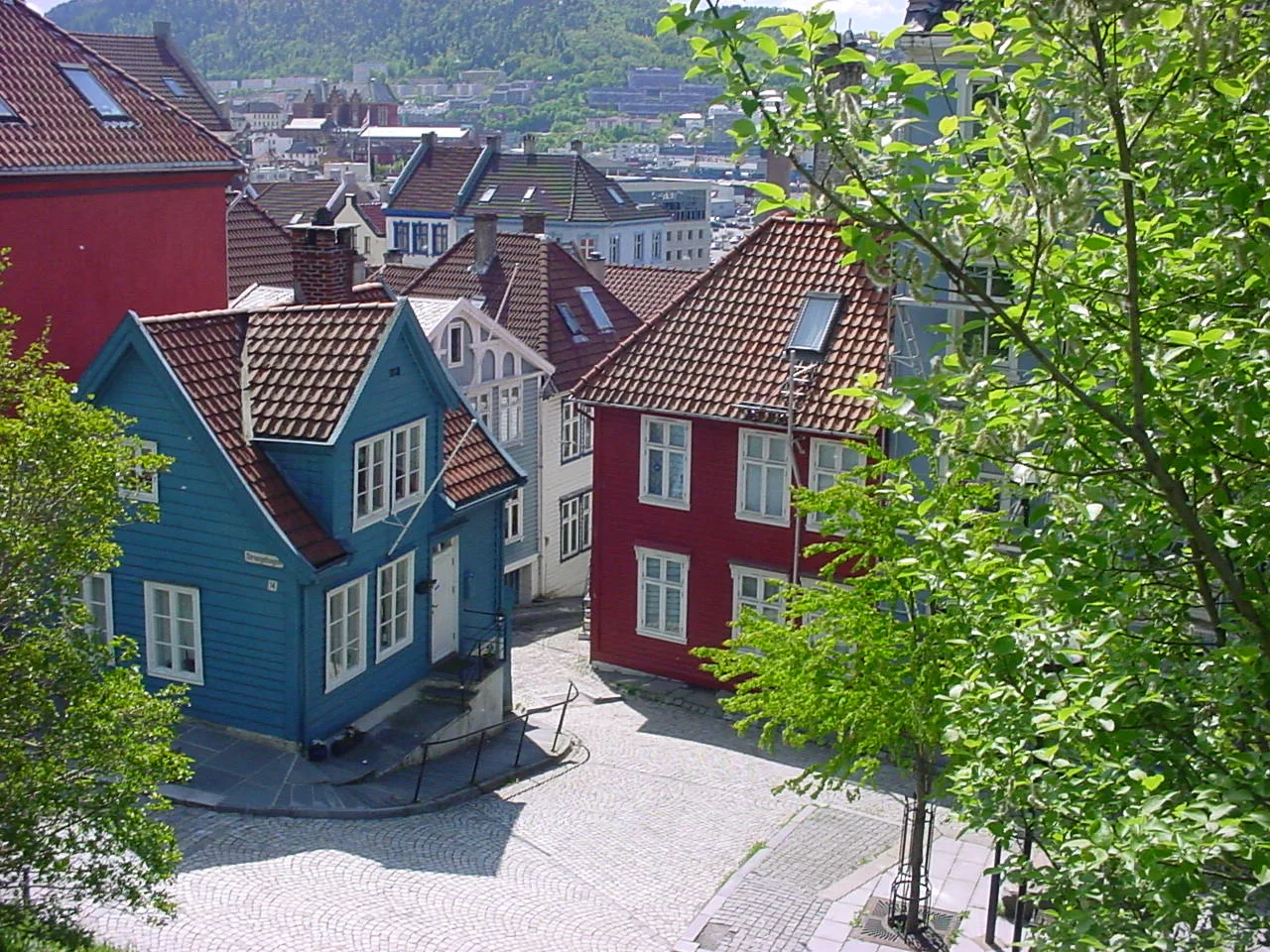
A climate in which it rains two hundred days a year is not a disaster but a design brief. You can see it in the city: covered passageways, wooden facades with paint that has to withstand damp, and an attitude to rain that is more practical than complaining.
The saying that there is no bad weather, only bad clothing, is often attributed to Norway. In Bergen it is not a motto but a daily necessity.