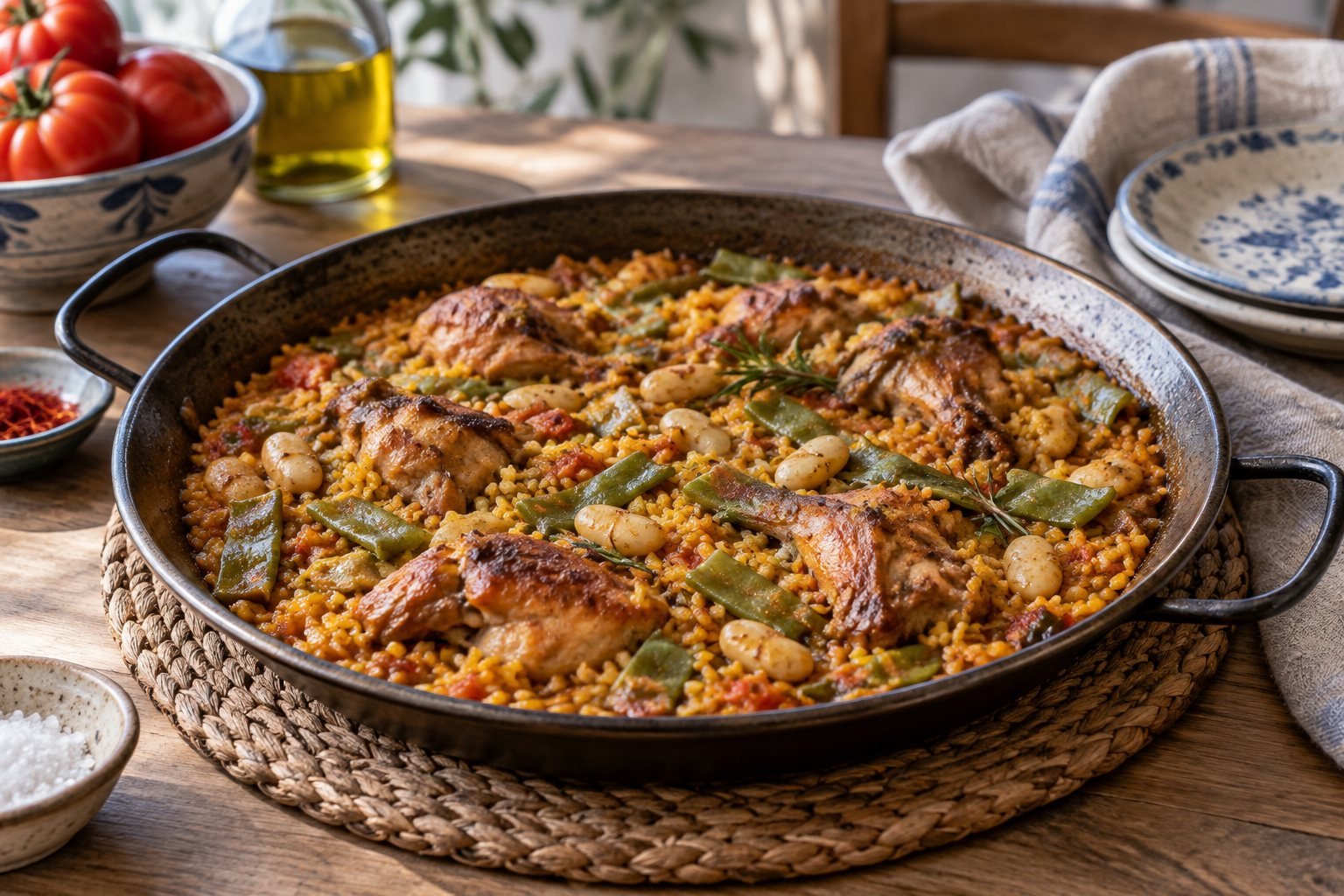
Paella: why a Valencian will not discuss chorizo
Spain's best-known dish comes from marshland near Valencia and contains no chorizo. What does belong in it is a shorter list than you would think.
There is a category of dishes about which one should not be casual in the country of origin. Paella belongs to it, and the gap between the argument there and the picture elsewhere is wide.
Where it comes from
Paella comes from the Valencian Community. In its modern form it traces back to the middle of the nineteenth century, to the countryside around the Albufera de València lagoon beside the city.
It is not a coastal dish and not a city dish. It is a dish from the rice fields, made of what that landscape had to hand. Short-grain rice, chicken, rabbit, flat green beans and white beans, saffron. Seafood was not originally in it.
How it spread
As the dish became known, it grew with whoever made it. Outside Valencia seafood went in, other meats, sausage including chorizo, and ever more seasonings.
Restaurants elsewhere in Spain often put that mixed version on the menu under the name paella valenciana. Valencians hold against that only the two original Valencian recipes deserve the name.
What you think of that is taste. But it helps to know the argument is not about chauvinism but about a name: the question is not whether something is good, but whether it may be called paella valenciana.
The layer at the bottom you want
After cooking there is a layer of scorched rice at the bottom of the pan. In Valencian it is called socarrat, and contrary to what a beginner assumes it is not an accident.
The layer develops on its own when you cook over a burner or an open fire. As long as it is not burnt it counts as the best part, and Valencians eat it with pleasure. People listen for it: towards the end of the cooking time you hear a soft crackling, and that is the moment the socarrat sets.
It also means that a paella finished in an oven under a lid misses something that characterises the dish.
The biggest mistake foreigners make
Stirring. Treat paella like a risotto and keep stirring, and you get a creamy rice porridge: possibly delicious, but it is something else.
In a paella the rice is spread evenly once and then left alone. The liquid has to sink through and evaporate, the grains have to stay separate, and that crust has to be able to form underneath. Stirring makes all three impossible.
That is also why the pan is wide and shallow: a thin layer of rice with plenty of surface, so the liquid draws off rather than stewing.
Resting is part of it
When the heat goes off the dish is not finished. A paella rests five to ten minutes after cooking, covered. In those minutes the last moisture spreads evenly through the grain.
And then the Thursday
Finally a detail everyone in Spain knows and almost nobody outside it: paella has traditionally appeared on restaurant menus on Thursdays.
Various explanations for that habit circulate, and I leave them for what they are. But it is a useful test for anyone eating out in Spain. A place with paella on a Thursday is following a custom. A place advertising it on a board outside every day is aiming at visitors.
Make it yourself
Ingredients
- 400 g short-grain rice, preferably bomba or senia
- 1 chicken in pieces, about 800 g
- 500 g rabbit in pieces
- 200 g flat green beans
- 150 g white beans, cooked
- 2 ripe tomatoes, grated
- 1 tsp sweet paprika
- a generous pinch of saffron threads
- olive oil, salt
- about 1.6 litres water or light stock
- optional: a sprig of rosemary
Method
- Heat oil in the pan and brown the chicken and rabbit all over. Take your time; this is the flavour base and little else is added.
- Push the meat to the edge, fry the green beans briefly, add the grated tomato and reduce to a dark paste.
- Stir in the paprika and immediately add the water; paprika burns in seconds.
- Add the saffron, white beans and salt. Simmer gently for twenty to thirty minutes.
- Scatter the rice in evenly. Spread it with the spoon and then do NOT stir again. This is the difference from risotto: here the grain must be left alone.
- Cook over high heat for about ten minutes, then eight to ten minutes more gently, until the liquid has gone.
- Turn the heat up for the last minute and listen: a light crackling means the socarrat is forming. If you smell burning, it has gone too far.
- Take off the heat, cover with a cloth and leave to rest for five to ten minutes before serving.
Allergens: none of the fourteen regulated allergens in the basic recipe. The basic recipe below contains none of the fourteen regulated allergens. Watch the stock, though: many stock cubes contain celery and gluten. If you use seafood instead of meat, crustaceans and molluscs are added.
Storage: Cool rice dishes within two hours; they can be reheated the next day until piping hot throughout. Do not keep them lukewarm.