The Camino: a shell as a signpost
Millions of people walk to a tomb in Galicia. The sign that shows them the way lies on the beach there.
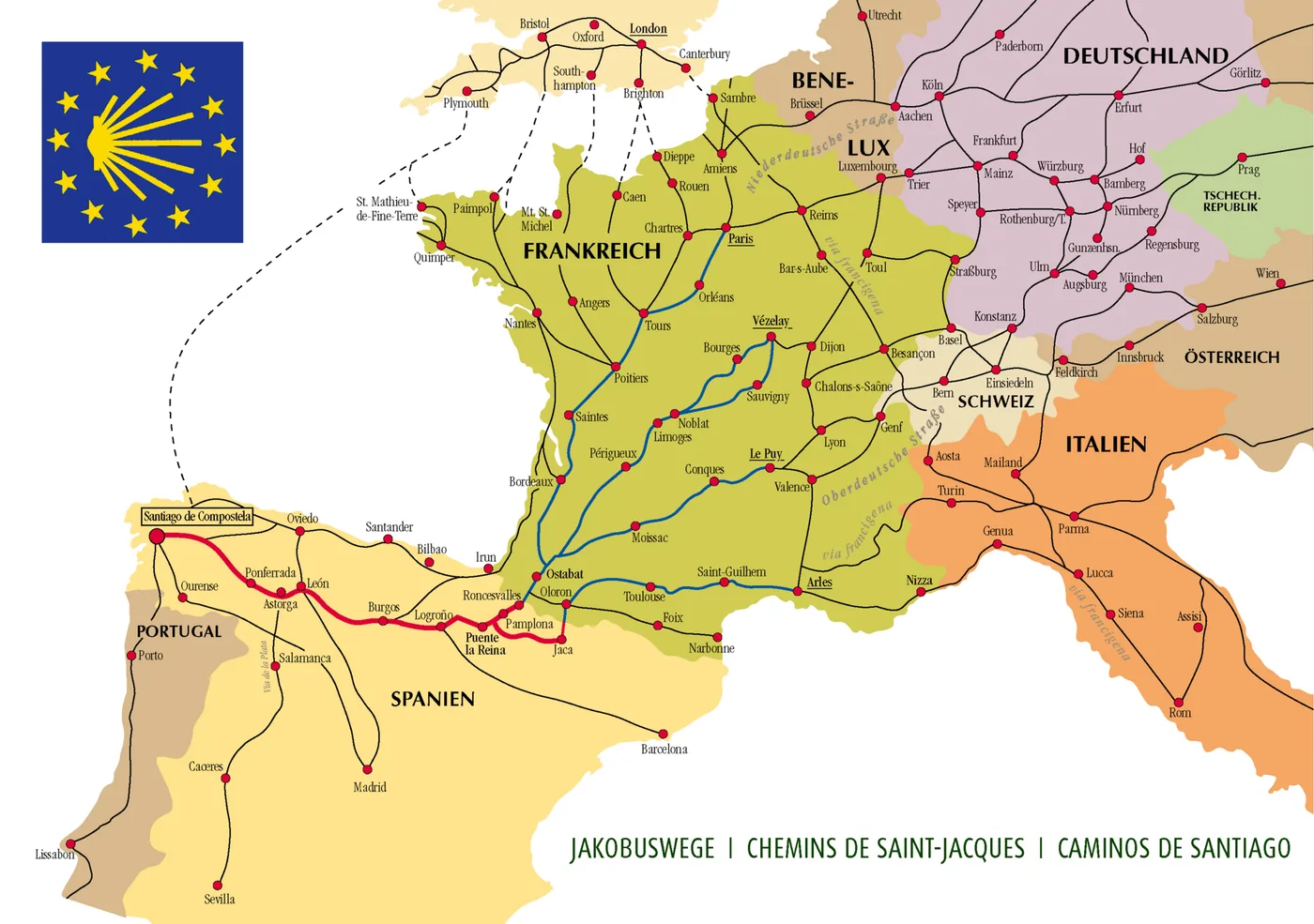
The Camino de Santiago is not one route but a network. From all over Europe roads converge on a single point: the shrine of the apostle James in the cathedral of Santiago de Compostela, in Galicia, where tradition holds that his remains lie.
That it is a network rather than a path explains why so many variants exist, and why people from different countries all say they are walking the Camino while never meeting one another.
The shell
The symbol of the route is the scallop shell, and today it serves quite literally as a signpost too: stylised on posts, walls and paving stones along the entire way.
What is seldom told is where that shell comes from. It is found in great numbers on the shores of Galicia, that is, precisely at the end of the journey.
That makes the sign something other than an arbitrary emblem. A pilgrim who returned with such a shell had provided proof: this thing comes from there, and I have been there. The symbol was originally not a direction marker but a receipt.
The compostela
That idea of proof still exists, in formalised form. Anyone who arrives can receive a compostela: a certificate that the pilgrimage has been completed.
There are conditions attached. The journey must have been made along an official route, and that is recorded with stamps collected along the way.
That is administrative and at the same time very old. In the Middle Ages a pilgrimage was not only an act of faith but also something you might have to demonstrate, for instance when it had been imposed as a penance or taken on as a vow. There had to be proof.
The name in French
In French the route is also called la voie lactée, the Milky Way.
That is not a poetic invention of a travel agency. The Milky Way runs across the night sky in the same direction as the route over land, from east to west, and disappears on the western horizon, where Galicia lies and where the continent ends.
For someone travelling without map or signs, that was a useful fact. The sky pointed the same way as the road.
Why it became busy again
The route was of great importance for centuries, then fell largely out of use, and has become busy again in recent decades.
What is striking about that revival is that it is only partly religious. Many people walk the Camino without a religious motive, for reasons ranging from sport to grief to the wish not to have to decide anything for a few weeks.
That is possible because the form of a pilgrimage works without its content. There is a fixed goal, a fixed direction, a daily rhythm set by distance, and people along the way doing the same. What stands at the end is a tomb for one and simply the end for another.
The shell on the pavement meanwhile points the same way for everyone.