Cinque Terre: five villages that exist only because of little walls
The terraces above the Ligurian Sea look like landscape. They are structures, and as soon as they are not maintained, the slope comes down.
On the Ligurian coast five villages cling to the rocks: Monterosso al Mare, Vernazza and three neighbours, together the Cinque Terre. They are part of the World Heritage site that also includes Portovenere and the islands of Palmaria, Tino and Tinetto.
What you see there is usually described as picturesque. It is. But above all it is the result of centuries of heavy labour.
What was built
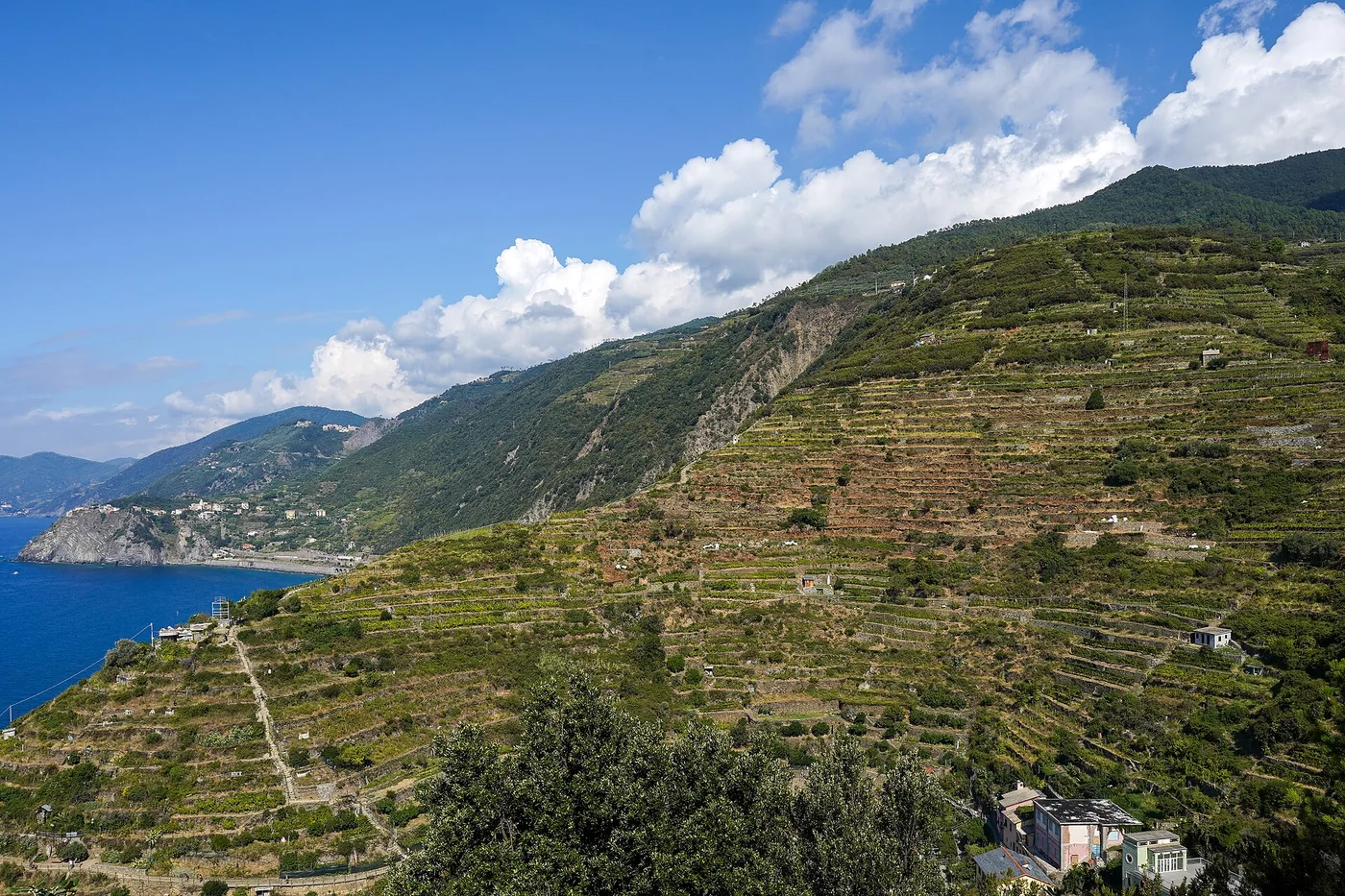
Over the centuries people here have built terraces on a rugged, steep landscape, right up to the cliffs above the sea.
A terrace on such a slope is not an excavation but a structure. A wall has to hold the earth back, and soil is brought in behind it to grow on. Those walls are stacked by hand, without mortar, and they run for kilometres.
The point of such a construction is not only that something can grow. It is that rainfall is carried off slowly. Water running over a bare steep slope takes soil with it; water sinking through terraces stays in the system. The walls hold the slope together.
Why it is still standing
That is also where the vulnerability lies. A stacked wall without mortar needs maintenance. Stones settle, roots push, water finds a way.
As long as there are people living off those terraces, they are kept up. Once agriculture declines that stops, and then it goes slowly and then quickly: a wall collapses, water runs free, and part of the slope comes away.
The source puts it plainly: because of the unstable terrain, landslides frequently cause portions of the trails to be closed. That is not incidental bad luck but a property of this landscape.
The paths
Paths, trains and boats connect the villages. Cars can only reach them with great difficulty, and that is the core of their character.
The best-known path is the Sentiero Azzurro, the Blue Trail, which links the five villages. That is the route most visitors come for.
One practical point causes confusion: paths are sometimes still referred to by their previous numbers, while a new numbering exists. Anyone going by an old sign or an old map may therefore walk a different path than they think.
Why closures belong to it
Visitors tend to see a closed path as a disappointment, or as poor management. Here it is rather the opposite.
A landscape that people have pinned to a steep slope moves. That parts of it are regularly shut means someone is looking and repairing. A route here that never closed would be suspect.
What you are visiting is therefore neither a nature reserve nor a museum, but a landscape that exists only as long as someone holds it up. The little walls you walk past are the reason the villages are still there.