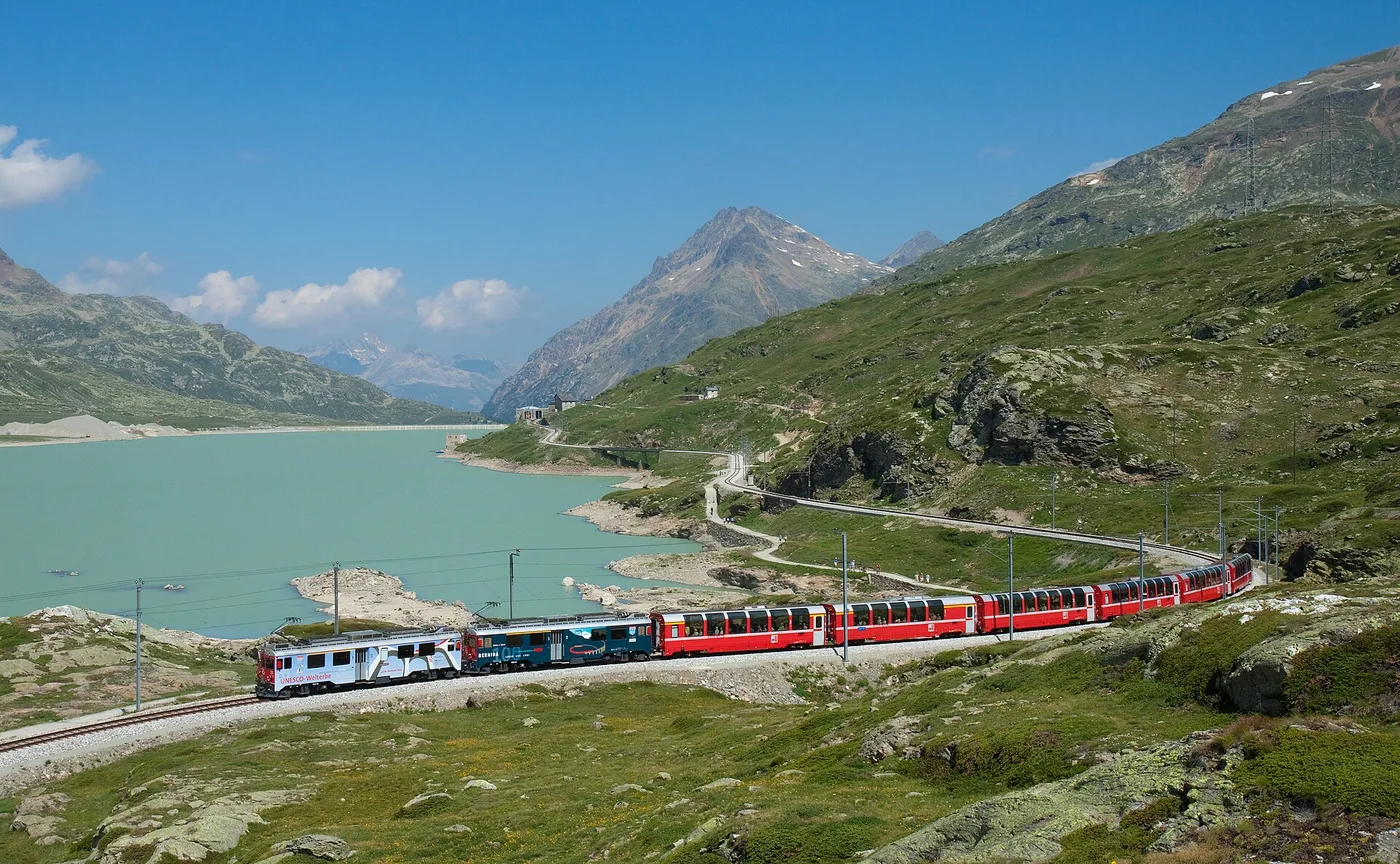
The Bernina: a train that climbs the Alps without a rack
Most mountain railways need a rack-and-pinion system. This one does not, and the way that was solved is clearest just before the final destination.
A train that has to climb a mountain has a problem: steel on steel gives little grip. Above a certain gradient the wheels start to spin, and then a toothed rack has to go between the rails for the locomotive to pull itself up on.
The Bernina line does without. It climbs over the Bernina Pass and then descends to Tirano in Italy, and it does so on ordinary adhesion: wheels on rails, nothing more.
The line was opened in two stages, on 1 July 1908 and 5 July 1910, and is owned by the Rhaetian Railway.
How to get up without a rack
The answer is simple and labour-intensive: you make the slope less steep by making the route longer.
That means the line does not go straight up a mountain but winds around it. It follows slopes at a gentle gradient, seeks out curves, and covers kilometres to gain height that on foot you would take in a fraction of that distance.
Between Le Prese and Miralago the line runs for a stretch along Lake Poschiavo, at 965 metres. There it does not climb; it holds its height and waits for a place where it can descend.
The Brusio spiral viaduct
The best-known part of the line is the answer to its hardest spot. Below Brusio the train has to lose height quickly, and there is no room to do so with a long loop.
The solution is the Brusio spiral viaduct: a viaduct of one hundred and sixteen metres that describes a full circle, in the open air, without a tunnel. The train runs over it, turns round on itself and comes out lower down.
That is special because spirals in the Alps are usually inside the mountain. A loop is normally laid in a tunnel, out of sight. Here it lies exposed in the landscape, among the vineyards, and from the train you can see where you were a minute ago.
What the figures show
The altitudes along the last stretch tell the story better than a description. Le Prese is at 965 metres, Brusio at 780, Campascio at 637, Campocologno at 553, and the Italian border at 530 metres.
That is a descent of over four hundred metres in a handful of kilometres, without a rack, with a train that simply brakes on its wheels. The spiral viaduct is where part of that difference is taken up.
Why it is worth knowing
A panoramic train ride is usually sold on its views: glaciers, valleys, cattle in the meadows. All of that is there too.
But the reason the line impresses people who care nothing for trains is that it makes tangible how a landscape is overcome without boring through it. There are tunnels, but the line is mainly a route that adapts to the mountain rather than going straight through it.
That is an old-fashioned way of building, and that is exactly why you can see it. In a modern base tunnel you notice nothing of the mountain. Here you spend an hour and a half looking at it while you descend it.