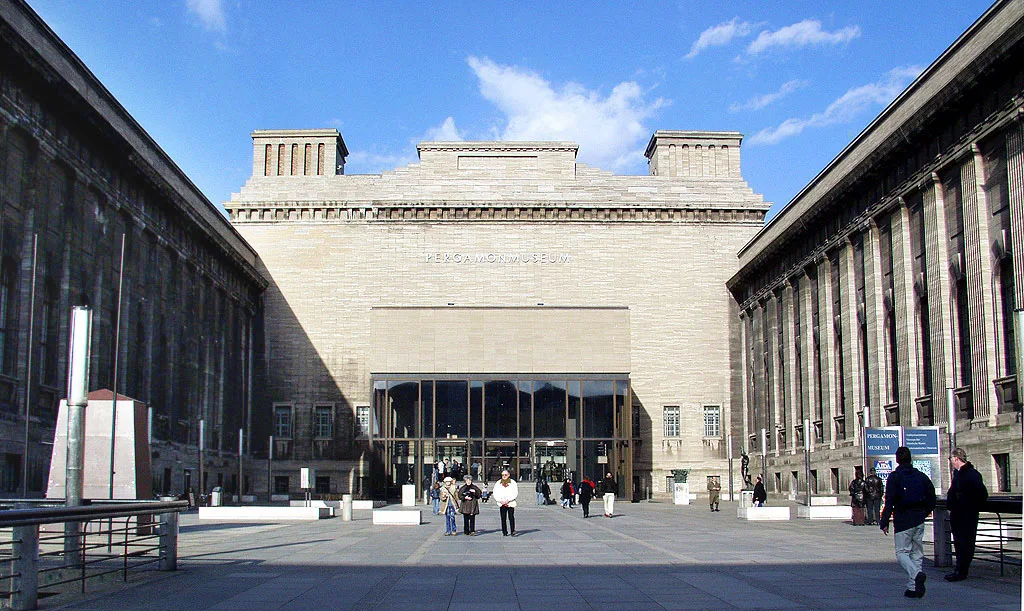
The Pergamon Museum: how to renovate a museum full of buildings
You do not move an altar and a city gate the way you move a painting. In Berlin the Pergamon Museum is therefore reopening in phases: according to the schedule, the altar returns on 4 June 2027.
Museums close for renovation fairly often. A wing shuts, a room is inaccessible for a season, and a year later everything is back.
In Berlin the Pergamon Museum has been completely closed since October 2023. A concrete first reopening date is now known: 4 June 2027, for the hall with the Pergamon Altar and the north wing, among other parts.
The south wing, with the Ishtar Gate among other things, is expected to remain under renovation until around 2037. A museum can thus be open again while an important part of the collection is still behind hoardings.
What stands inside
To understand why that weighs so heavily, you need to know what stands in that building. This is not a museum with paintings on the walls but with buildings inside it.
The Pergamon Altar. The Market Gate of Miletus. The Ishtar Gate with the Processional Way of Babylon. The Mshatta facade. These are not objects you move in a crate; they are reconstructed architectural fragments that were built up in the halls and around which the building was put.
The complex also houses the Vorderasiatisches Museum and the Museum fur Islamische Kunst.
Why it takes so long
That is exactly the problem. A museum with such large architectural fragments cannot be emptied as easily as a room of paintings. Some parts are protected in place, other components are carefully dismantled or moved.
The renovation has to take account of the fragile collection and of the building. That requires coordination between builders, curators and conservators, instead of a single empty building site.
The announced reopening in 2027 is therefore a milestone, not the end of the whole project. For a visit it matters which part you want to see; check the current museum information beforehand.
What a museum does while it is closed
In 2018 a temporary space opened close to Museum Island with a panorama: a circular painted image of the city of Pergamon.
That is a solution that says something about the problem. If you cannot show the altar, you can show the world it comes from. It is not a replacement, and it does not pretend to be one.
The question underneath
A phased renovation like this makes an old museum question very concrete: how do you keep a collection accessible while protecting it for later?
The usual answer is: for later. Conservation comes before display, because what is broken can never be shown again. There is little to argue with in that reasoning.
The phased reopening offers a partial answer. The altar can receive the public again while work continues elsewhere in the complex. Preserving and showing thus do not have to wait for each other across the whole building.
Visitors will soon see a renewed hall. Behind it lie years of work on a historic building with a collection that makes special demands.
That makes this more than a renovation notice. The Pergamon Museum shows that a collection needs not only space, but also maintenance, patience and a plan to make it visitable again.