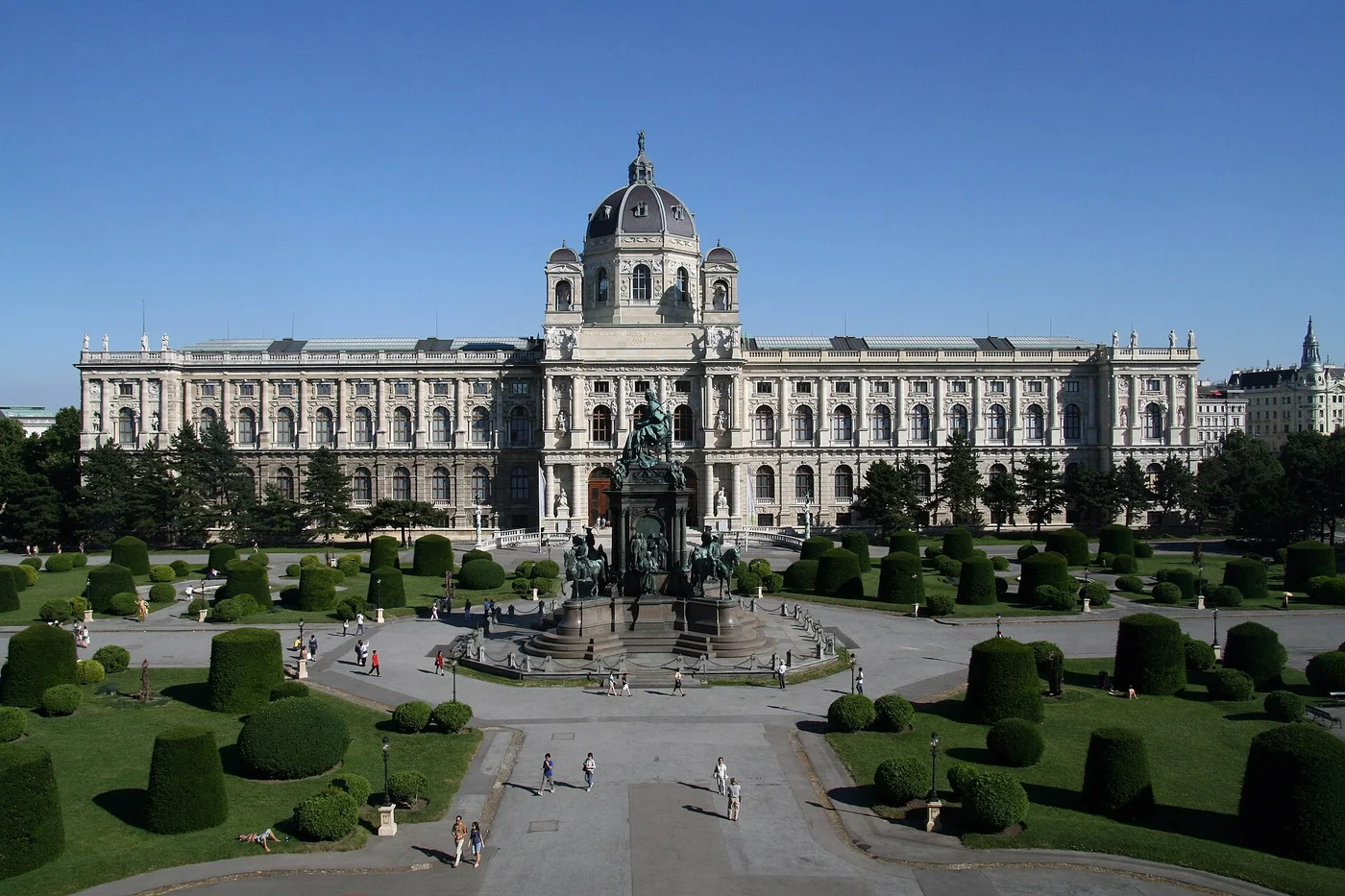
Two museums facing each other
On Vienna's Ringstrasse two identical buildings stand opposite one another. That is not a symmetrical whim but a statement about what art and nature are worth.
On Maria-Theresien-Platz in Vienna stand two buildings that are each other's mirror image. The same dimensions, the same facade, the same dome, with a square between them.
One holds the Kunsthistorisches Museum, the other the Naturhistorisches. They were built between 1871 and 1891, on the Ringstrasse, and one of the architects was Karl von Hasenauer.
Why there are two
The emperor commissioned both buildings at once, with a double purpose: to create a fitting home for the Habsburgs' formidable art collection, and to make that collection accessible to the general public.
That second part is why they look as they do. A collection hanging in a palace needs no facade; those invited come in. A collection that becomes public must have a building that says you may enter.
That two were built, and exactly alike, says something else. Art and natural science were given the same format, the same place and the same dignity. They do not stand in rank but opposite one another.
What the form does
The buildings are rectangular, with symmetrical Renaissance Revival facades of sandstone, fitted with large arched windows.
The Renaissance Revival was no arbitrary choice. By building in the language of the fifteenth and sixteenth centuries, Vienna placed its new museums in line with the Italian palaces the collections come from, and presented the holdings as a continuation of a European tradition rather than as the property of a family.
The large arched windows are meanwhile simply practical. For a museum predating electric light, daylight is not atmosphere but a condition.

The square as part of the building
What makes the ensemble special is not the building but the arrangement.
Two identical volumes with a square between them force a comparison. You cannot visit one without seeing the other standing there. The choice of which of the two you enter is a choice the design presses upon you.
In the nineteenth century that was a statement about how a state orders its knowledge: the created and the made, side by side, equally large.
Why that stands out now
Museums are rarely put up like this today. A new museum is a building in its own right, often intended precisely not to resemble anything else.
The Viennese pair does the opposite: it builds its meaning out of repetition. Neither building can be understood alone, because half of what they say lies in the fact that there is a second.
Anyone coming for the paintings therefore sees only half of what was put there. The other half stands across the square and is about something entirely different.