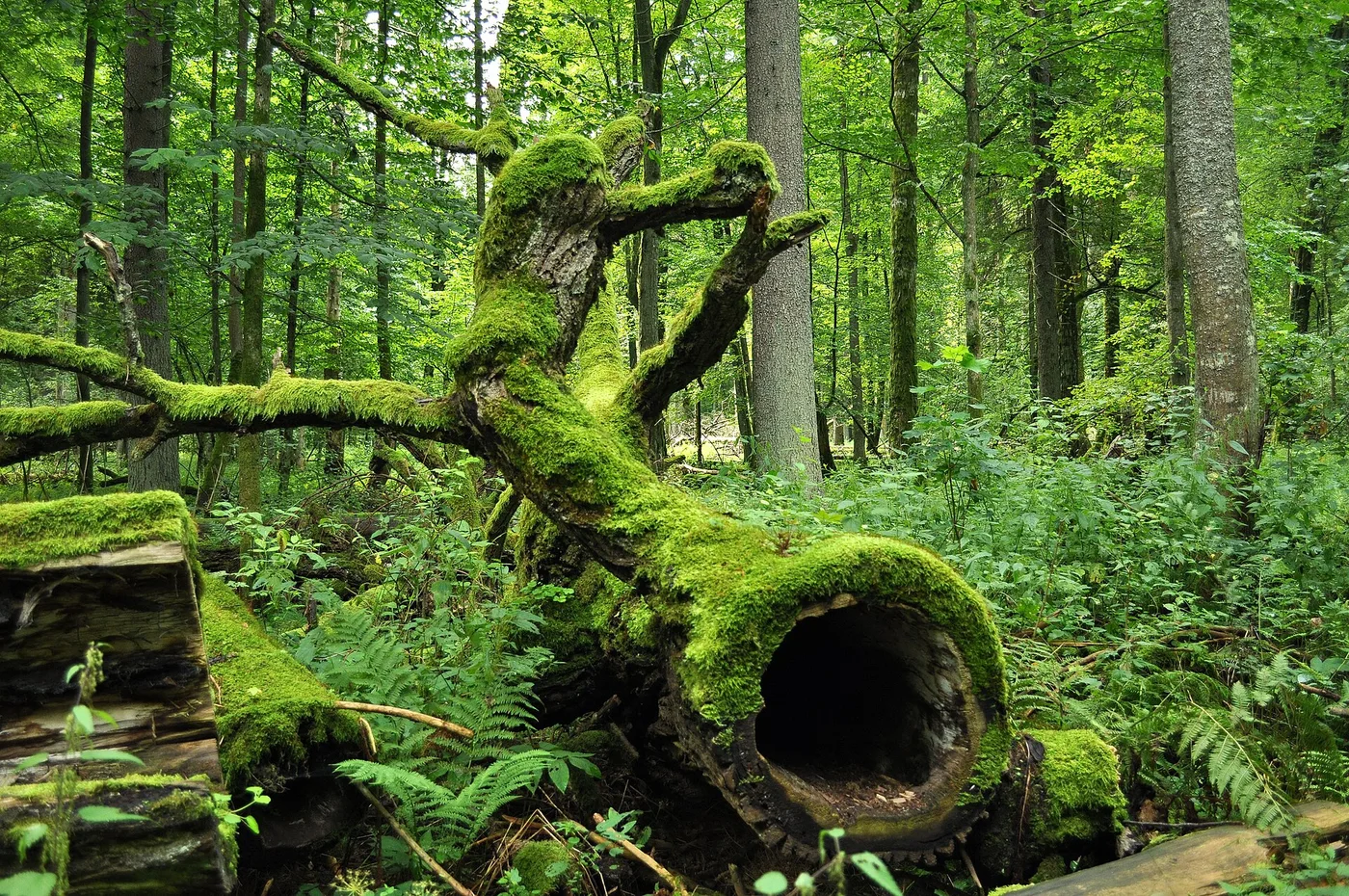
Bialowieza: the forest where dead wood is left to lie
On the border of Poland and Belarus stands one of the last pieces of primeval forest on the European plain. The difference from an ordinary forest shows in what lies on the ground, not in what stands.
Once a continuous forest covered the European plain. Almost nothing of it remains. Bialowieza, on the border between Poland and Belarus, is one of the last and largest remnants.
The area covers more than three thousand square kilometres and is designated both a World Heritage Site and a Natura 2000 site.
What makes a primeval forest different
The temptation is to think that a primeval forest has older or thicker trees. That is partly true, but the real difference lies on the ground.
In a managed forest, dead wood is removed. That is not untidiness but policy: fallen trunks count as a fire hazard and a source of disease, and they are also timber worth money.
In Bialowieza it stays where it falls. Trunks topple, lie for years, soften, become overgrown, and eventually sink into the soil.
Why that matters
Dead wood is not waste but habitat. Species live in it that can go nowhere else, such as the flat bark beetle Cucujus cinnaberinus, a species classed as near threatened.
That is the core of the difference. A managed forest can look magnificent and have many trees and still lack a whole group of species, simply because it has been tidied. What grows in a primeval forest grows partly in what has died.
The bison
The forest is home to more than eight hundred European bison, Europe's heaviest land animal. That they roam there is anything but a given; the species became extinct in the wild and was brought back from animals that lived in captivity.
A heavy grazing animal in such numbers is also a shaping force in its own right. The forest you see is the result not only of non-intervention but also of what that herd does.
The dispute
How this forest should be managed has been fought over for years, and both sides put forward arguments that sound reasonable in themselves.
In 2011 the director of the Polish national park said that felling and replanting would bring the forest back in fifty years. That is true, if you define a forest as trees.
But that is exactly where it chafes. Fifty years produces a forest with trees in it and without the accumulation of dead wood, without the species that live on it, and without the continuity that took thousands of years. What returns in half a century is the silhouette.
What you see there
For a visitor the difference is first disappointing and then surprising. A primeval forest looks messy. Trunks lie criss-crossed, dead trees stand upright, and there is no path that neatly goes round anything.
Once you grasp that, you look at a managed forest differently. That trim, tidy floor you can walk across easily is not the natural state of a forest. It is the result of someone taking something away every year.