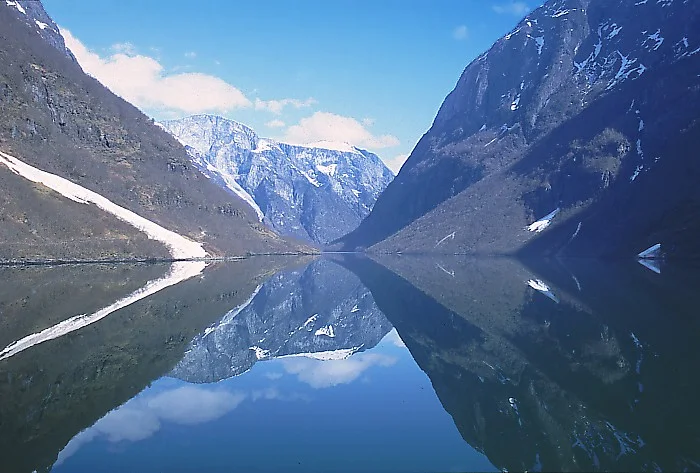
Fjords: valleys cut deeper than the sea
A fjord is not a valley that happened to fill up. It is a valley scoured so deep that its floor lies far below sea level, and at the exit there is a sill.
A fjord is a long, relatively narrow sea inlet with steep sides, in a valley once formed by a glacier and later flooded.
That sounds like a valley that filled up when sea level rose, and in part it is. But the real story is in the depth.
How deep is deep
The Sognefjord in Norway reaches about thirteen hundred metres below sea level. Not the mountains above it, the floor beneath it.
This is where the ordinary explanation fails. Running water cannot cut below the level it flows out to; a river stops at the sea. A valley lying more than a kilometre below sea level therefore cannot have been made by a river.
A glacier can. Ice flows under its own weight and takes no notice of sea level; it scours through whatever it passes. That overdeepening relative to the ocean is the strongest evidence that fjords are of glacial origin.
What it started with
Fjords were not carved out of nothing. They formed in valleys that already existed before the ice age, with gently sloping floors, as river valleys have.
The glacier followed those existing valleys and rebuilt them. Where a river makes a V-shaped valley, ice leaves a U-shaped one with a broad floor and steep sides, ending abruptly rather than tailing off.
When the ice went and the sea came in, such a valley became a fjord. The same shape above sea level yields no fjord but an ordinary Alpine valley.
The sill at the mouth
Almost every fjord has a sill of bedrock at its exit, shallower than the rest.
That seems contradictory: why would the scouring be least at the mouth? The answer lies in the behaviour of the ice. At the mouth the glacier could widen and spread, and spreading ice exerts less force on the ground beneath. Add to that the terminal moraine, the debris a glacier pushes ahead and leaves at its furthest stand.
That sill has consequences you can see on the spot. Water forced through a narrow, shallow passage accelerates. In some fjords that produces extreme currents and even saltwater rapids: rapids in the sea rather than in a river, reversing with the tide.
And where such a sill rises above sea level, no seawater gets in at all. The result is then not a fjord but a freshwater lake of the same shape.
Why it looks like that
The combination of those three properties explains the view people come for: walls rising straight out of the water, water hundreds of metres deep close to shore, and a landscape without a beach.
There is no gradual transition from land to sea because the glacier did not make one. What you see is the side of a valley, with the water simply standing against it.