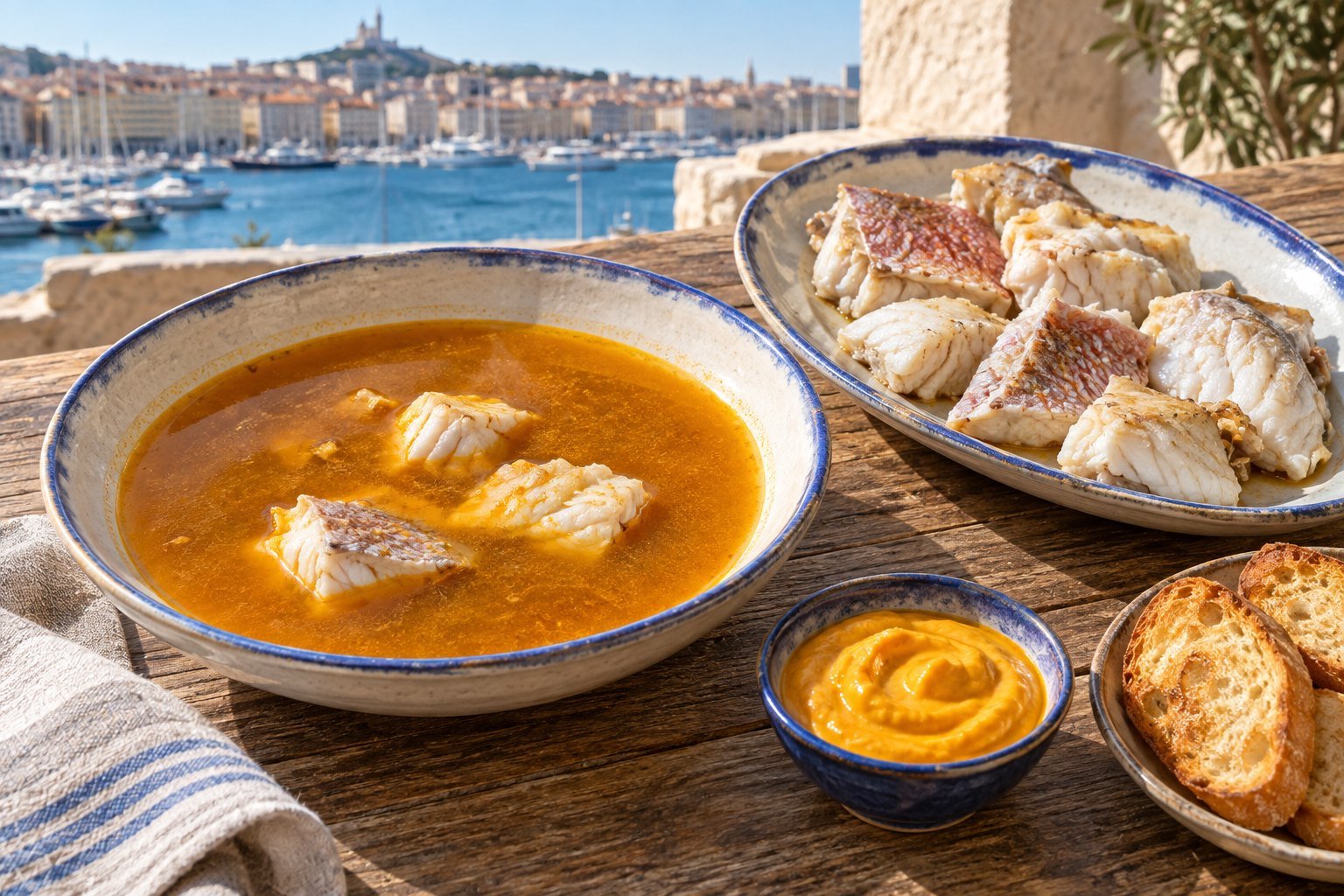
Bouillabaisse: the soup made from the fish nobody would buy
What now appears on the priciest menus in Marseille began as what the fishermen could not sell. The name gives away how it is supposed to be made.
Over the course of a century bouillabaisse has moved from using up leftovers to luxury dish, and that shows in the price but not in the origin.
The dish was made by fishermen in Marseille, from bony rockfish. Those were the species they could not sell to restaurants or at market: too many bones, too little flesh, too ugly. What was left went into the pot.
What the name says
The name is a set of instructions. Bouillabaisse comes from bouillir, to boil, and abaisser, to lower the heat.
Hard to the boil first, then back and left to simmer gently. That is exactly what a broth of heads and bones needs, and what goes wrong if you let it boil on or stand too long.
Three fish, at least
A traditional bouillabaisse contains at least three kinds of fish. Usually red rascasse, sea robin and European conger.
That is not arbitrary. They are species with different structure and different gelatine content; together they give the broth a body that one species cannot reach. That the fishermen knew this without having heard of collagen is the ordinary story of kitchen knowledge: first it works, then comes the explanation.
What sets it apart from other fish soup
Every coastal region in Europe has a fish soup. The difference here lies in the broth: the choice of Provençal herbs and spices.
Fennel, orange peel, saffron, thyme and bay. It is above all that combination of fennel and orange that makes it Provençal; it is a flavour you will not meet in a Breton or Portuguese fish soup.
The order is part of the dish
In Marseille the broth is served first and the fish separately afterwards. That is not a chef's presentation idea but the traditional way of doing it.
With the broth comes rouille: a mayonnaise of olive oil, garlic, saffron and cayenne, spread on grilled bread that sinks into the soup. Sharp, thick and fiercely coloured, against a broth that is sweet and aromatic.
Serve it in one bowl with the fish in the soup and you have made a good fish soup. But then the broth misses its moment, and that moment is what the dish is about.
Why it became expensive
The irony is familiar but unusually sharp here. Bouillabaisse was food of poverty because rockfish was worthless. When the dish became famous, the fish became scarce and the price high.
Today it appears on menus where it costs more than the meat those fishermen could not afford. The dish has stayed the same; only the value of the raw material has been reversed.
Make it yourself
Ingredients
- 2 kg mixed firm sea fish on the bone, at least three kinds, cleaned
- 1 fennel bulb, 2 onions, 1 leek, all roughly chopped
- 4 cloves of garlic
- 3 tomatoes, in pieces
- 1 strip of orange peel
- a generous pinch of saffron
- thyme, bay leaf, fennel seed
- olive oil, salt, pepper
- for the rouille: pasteurised egg yolk equivalent to 2 yolks, suitable for uncooked use according to the label, 2 cloves of garlic, saffron, cayenne pepper, 200 ml olive oil, pinch of salt
- toasted slices of baguette
Method
- Ask the fishmonger for the heads and bones separately. That is where the soup is; the fish flesh is secondary for the broth.
- Soften the fennel, onion, leek and garlic in olive oil. Add the tomato, orange peel, herbs and saffron.
- Add the heads and bones and just enough water to cover everything. Cook for thirty to forty minutes, no longer; fish soup turns bitter if it infuses too long.
- Strain the broth and press the solids well. Season.
- Make the rouille with pasteurised egg yolk that the label says is suitable for uncooked use. Pound the garlic, saffron, cayenne and salt to a paste, whisk in the pasteurised yolk and slowly add the oil while whisking. Do not use raw shell eggs for this. Keep the rouille covered in the fridge until serving.
- Heat the broth and cook the fish in it in pieces, from firm to delicate, in a few minutes.
- Serve the broth first, with toasted bread and rouille. The fish comes afterwards, separately. That is not a presentation gimmick but the traditional order.
Allergens: fish, egg, gluten. Fish in the soup, egg in the rouille, gluten in the toasted bread. If you add crustaceans or shellfish, those are added too.
Storage: Put leftover broth, covered, in the fridge within two hours and use within two days. Preferably cook the fish just before serving. Make the rouille just before the meal and keep it chilled; also follow the storage instructions on the egg product.