Giant's Causeway: why cooling lava breaks into hexagons
Forty thousand columns that fit together so neatly they look man-made. The legend turns them into a causeway to Scotland; geology tells a different, at least as fascinating story.
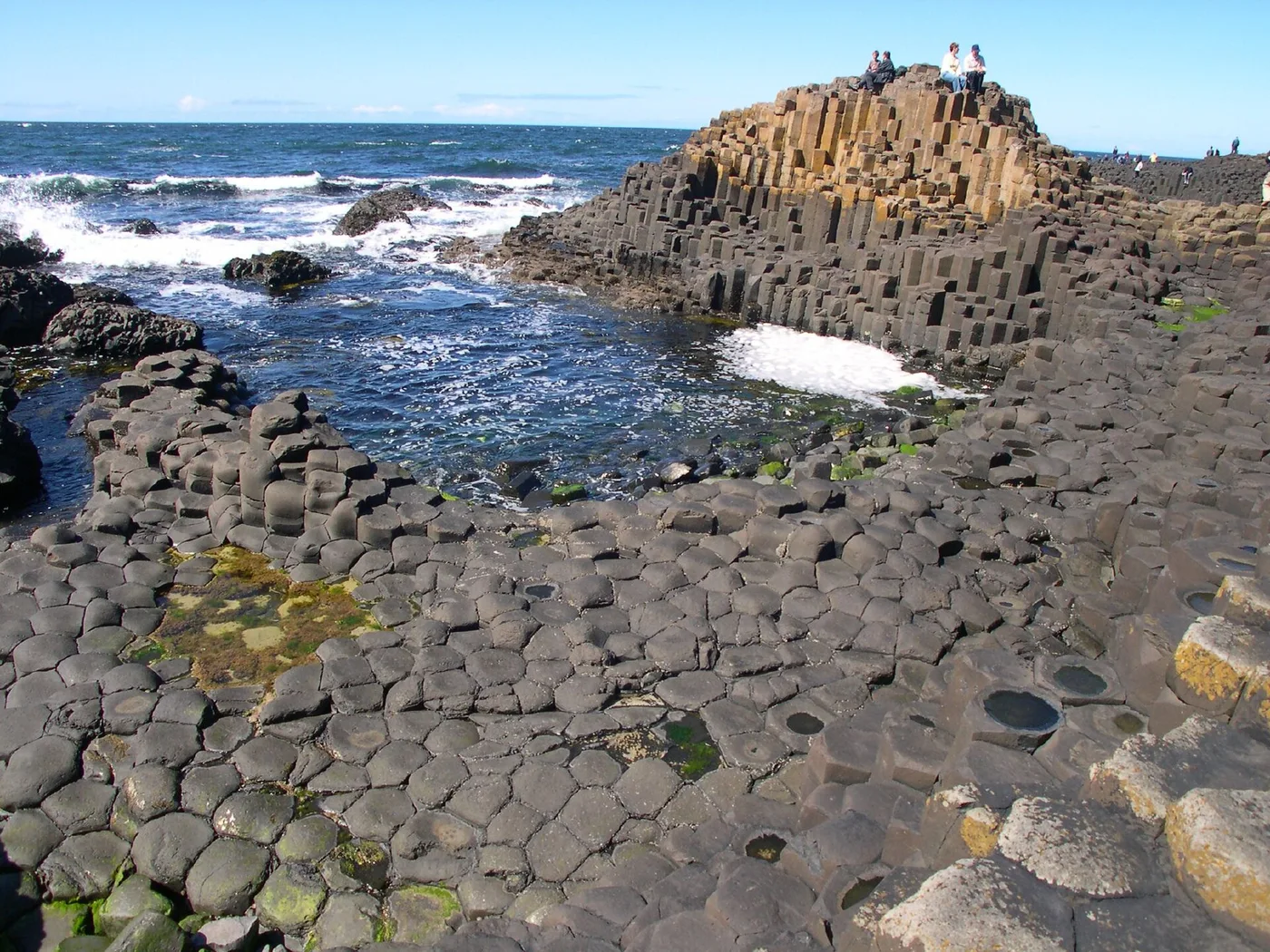
On the north coast of County Antrim, some five kilometres north-east of Bushmills, a floor of stone runs into the sea. Roughly forty thousand basalt columns, most of them with five, six or seven sides, packed so tightly that a knife barely fits between them.
It is precisely that regularity that caused confusion for centuries. Something this ordered ought to have been made.
What actually happened
The columns are the result of an ancient volcanic fissure eruption, part of the North Atlantic Igneous Province that was active in this region during the Paleogene. Lava flowed out, and that lava had to cool.
Cooling rock contracts. Contraction creates stress, and stress takes the cheapest way out: cracks. The remarkable part is that those cracks do not run at random.
The cooling front moves from the surface into the mass. After the first few metres the crack pattern organises itself into a grid of more or less equal width. How wide those columns become depends on the material properties of the rock and on the speed at which that front advances. Slow cooling gives broad columns, fast cooling narrow ones.
Hexagons are not a law here but an outcome. It is the shape that divides a surface most efficiently under even stress, which is why it turns up most often. Hence the pentagons and heptagons in between: where the stress was uneven, the pattern gave way.
This is not a basalt-only phenomenon either. Columnar jointing also occurs in andesite, rhyolite and tuff, in lava flows as well as in shallow intrusions.
Why this rock changed science
The Causeway was more than a curiosity. In the eighteenth century a fierce debate raged over where basalt came from: precipitated from water, or solidified from fire.
This coast supplied the evidence. Susanna Drury painted the coast around 1739. Prints after her work spread the image in the 1740s and helped geologists study the landscape. In October 2022 the International Union of Geological Sciences included the Causeway's Palaeocene rocks in its list of one hundred geological heritage sites worldwide, precisely because of that role.
Why Scotland is in the story
The story has the giant Fionn mac Cumhaill building the causeway so he could walk to Scotland, and his opponent Benandonner taking fright halfway, fleeing back and destroying the causeway behind him.
On the Scottish side, similar basalt columns stand at Fingal's Cave on Staffa. Both landscapes belong to the volcanic history of this region, but they arose from different eruptions. They were not the two ends of a single stone bridge.
The similarity between the two coasts fits the story of a giant's causeway beautifully. That makes the legend understandable, without turning it into a geological explanation.
One correction belongs here: in Irish mythology Fionn mac Cumhaill is not a giant at all. He is a hero with supernatural gifts. That he grew into a giant in this one story is because the landscape called for one.