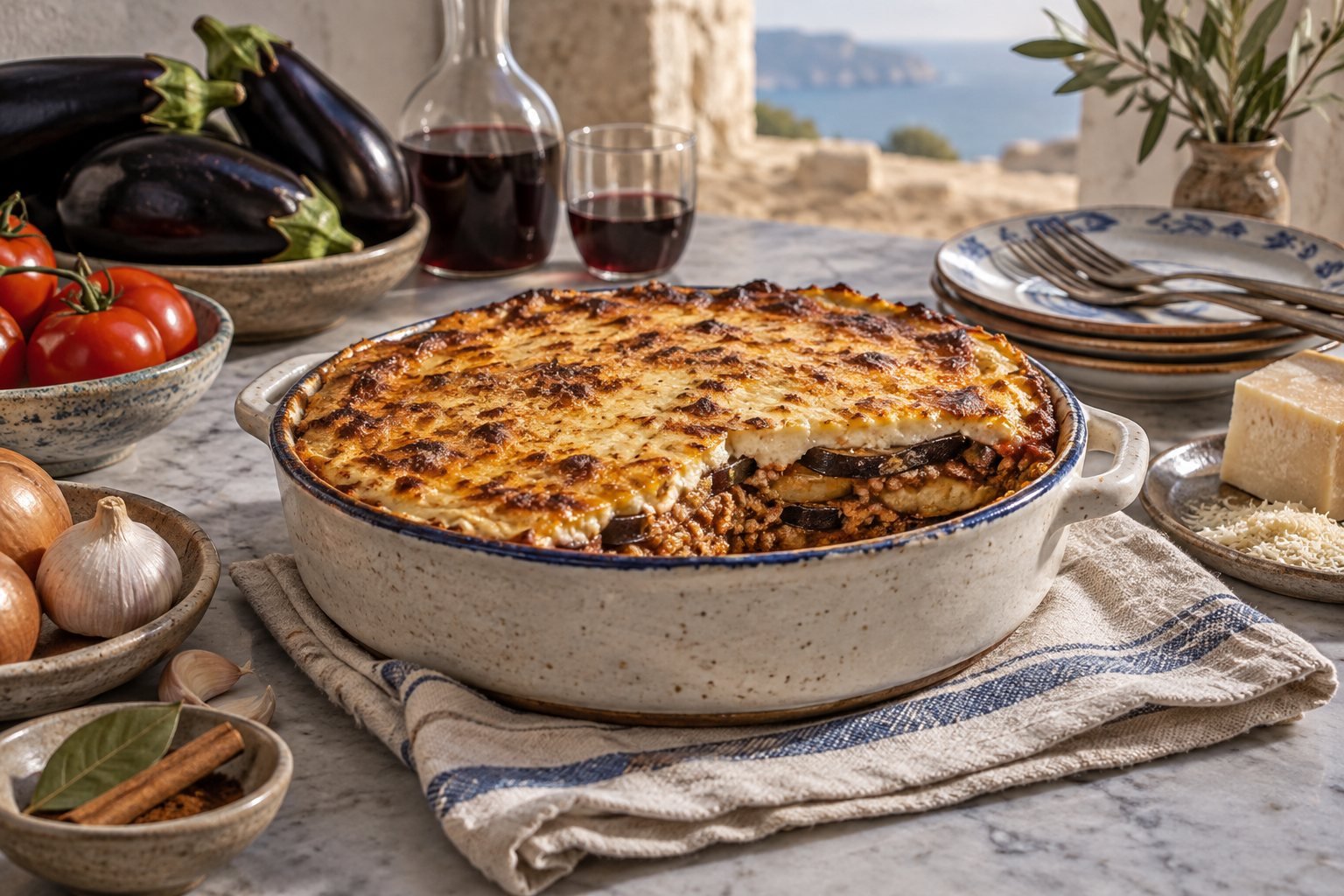
Moussaka: the dish is older than its most famous layer
The white sauce on top was added only in the 1920s, by one cook with a mission. What lies beneath is far older and far more widespread.
For most people outside Greece moussaka is a fixed image: aubergine, minced meat, and on top a thick layer of béchamel that turns golden in the oven.
That top layer, the layer by which the dish is recognised, is its youngest part.
Where it comes from
The dish is associated with Egypt, Greece, the Middle East and the Levant. There are many local and regional variants, and not all of them look like the version known in northern Europe.
The common core is modest: aubergine or potato, layered with minced meat and sauce. In some regions it is even a cold dish, closer to a cooked salad than to a baked casserole.
The cook who made it a national dish
The modern Greek variant, with that béchamel, was created in the 1920s by Nikolaos Tselementes.
That is remarkably precise for a traditional dish. Usually we do not know who devised something; here we do. Tselementes was a cook with a programme: he wanted to elevate Greek cooking, and in his day that meant making it more French. The milk-based sauce thickened with flour or egg comes from that tradition.
The result is a dish now regarded as thoroughly Greek that owes its characteristic layer to a French technique. That makes it no less Greek. It shows how quickly something can become national.
The fasting version
Tselementes also devised a plant-based version, for the Orthodox fast.
That detail is often skipped and it is the most illuminating of all. In a country with a fasting calendar, a dish is only complete if it can also appear during the fasting weeks. That a version without meat and dairy belonged to it from the start says the dish was meant to serve all year, not only as a feast.
Where it goes wrong at home
Two things decide whether a moussaka succeeds, and neither has to do with the recipe.
The first is the aubergine. It soaks up oil like a sponge. Deep-fry the slices and you get a dish that stays greasy. Salting, draining, patting dry and then baking in the oven with a little oil gives the same result without the pool at the bottom.
The second is the sauce. The meat sauce must be thick and free of loose liquid before it goes into the dish. Anything you leave in comes out again in the oven and settles at the bottom.
And then waiting
The last step appears prominently in no recipe. A moussaka must stand for at least twenty minutes after baking.
Straight from the oven the béchamel is still liquid and every portion falls apart. After half an hour you cut neat blocks in which the layers stay visible. It is a dish that only takes its shape while cooling.
Make it yourself
Ingredients
- 3 large aubergines, in 1 cm slices
- 600 g minced lamb, or a half-beef, half-pork mince mixture
- 2 onions, 3 cloves of garlic, finely chopped
- 400 g chopped tomatoes
- 1 cinnamon stick or 1/2 tsp ground cinnamon
- 1 bay leaf, pinch of nutmeg
- 100 ml red wine
- olive oil, salt, pepper
- for the bechamel: 80 g butter, 80 g flour, 800 ml milk, nutmeg, 2 egg yolks, 60 g grated kefalotyri or pecorino
Method
- Sprinkle the aubergine slices with salt and leave to drain for half an hour. Pat dry. This draws out moisture and bitterness and saves oil later.
- Fry or grill the slices until golden. Baking them in the oven with a thin layer of oil works better than deep-frying; aubergine soaks up oil like a sponge.
- Soften the onion and garlic, brown the mince, deglaze with the wine and reduce. Add the tomato, cinnamon, bay leaf and herbs and simmer gently for thirty minutes to a thick sauce with no free liquid.
- Make the bechamel: melt the butter, stir in the flour and cook for two minutes without colouring. Add the milk in stages, stirring all the time, to a thick sauce. Off the heat, stir in nutmeg, cheese and yolks.
- Layer up: aubergine, meat sauce, aubergine, and the bechamel on top.
- Bake for 45 to 55 minutes at 180 degrees until the top is golden.
- Leave the dish to stand for at least twenty minutes before cutting. Straight from the oven it falls apart; that is not failure but impatience.
Allergens: milk, gluten, egg. Milk and flour in the bechamel, egg if you bind it with yolk. If you use stock, watch for celery.
Storage: Cool within two hours. Two to three days in the fridge; reheat until piping hot throughout.