The Danube Delta: a landscape that floats
Where the Danube disappears into the Black Sea lies the best-preserved delta in Europe. A large part of it is attached to nothing.
The Danube runs for almost three thousand kilometres and then stops. Not abruptly, but in a fan of arms, channels, lakes and reed beds that passes gradually into the Black Sea.
After the Volga Delta it is the second largest river delta in Europe, and the best preserved on the continent. Most of it lies in Romania.
What plaur is
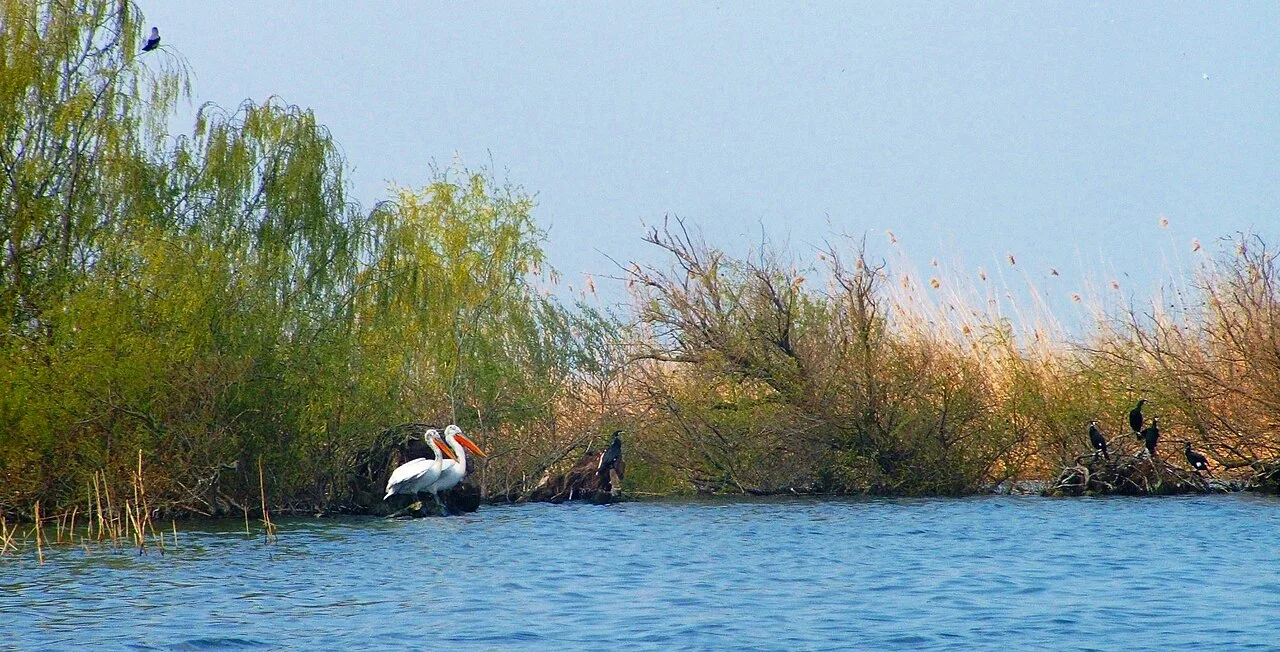
The characteristic component of this landscape has a word of its own: plaur. These are floating reed islands.
Reed grows here in mats so dense that the root systems interlock into a tough weave. That pack comes loose from the bottom and stays afloat, carrying on top of it another layer of plant remains and soil.
The result is ground that is not ground. Shrubs can stand on it and animals can walk on it, and yet it moves with wind and water level. Anyone mapping this draws something that will lie elsewhere next year.
The vegetation consists mainly of common reed, Phragmites communis, the same species that stands in Dutch marshes. The difference is the scale: here it is a continuous surface stretching over tens of kilometres.
Why there are so many birds
A delta is an in-between place: fresh water turning salt, land turning water, shallows shifting with the season. That yields an unusual number of different niches, and therefore many species.
Great white pelicans and great crested grebes breed here, among others. The pelican is the animal most visitors come for, and that the species occurs in numbers in Europe almost only here says enough about how rare this kind of area has become.
The protection, and what came before it
The area was recognised early. In Romania part of the delta was designated a reserve as long ago as 1938.
The rest followed later. On 21 May 1991 it was designated a Ramsar site, and under the UNESCO Man and the Biosphere programme 6,264.03 square kilometres were established as a biosphere reserve, shared between Romania and Ukraine.
That shared management is not a formality. A delta is one system; what happens upstream or on one side of a border comes back on the other.
What went wrong in between
Between those dates of protection lies a period that should not be skipped. In the communist era parts of the delta were diked and drained, for agriculture and fish farming.
That is the familiar pattern: a marsh that appears to be lying idle is converted into something productive. Some of those works were later undone or returned to nature.
That the delta nevertheless counts as the best preserved in Europe says most about how things went elsewhere. This is not the area least damaged because nobody tried, but because it proved too big and too wet to tame entirely.