The Elbe Sandstone Mountains: towers cut out of a sea floor
Between Dresden and the Czech border sandstone pillars stand in a forest. Their material once lay on the bottom of a sea.
South-east of Dresden the landscape changes abruptly. Free-standing rock towers rise between the trees, there are ravines you have to pass through sideways, and bridges hang between pillars.
That area is called the Elbe Sandstone Mountains, and the name is literal: it is sandstone carved out by erosion.
How it got there
The material is older than the landscape. The sandstone formed from deposits that accumulated millions of years ago on the bottom of a sea. Large rivers carried that sand in, layer upon layer, until a thick pack lay there that turned to stone under its own weight.
Then it came up and the water got at it. Rain and rivers cut into that pack, and sandstone cuts well: hard enough to stay standing, soft enough to wear.
The Elbe itself plays the most striking part. The river breaks through the range in a steep, narrow valley, and that valley is the reason the area is accessible at all.
Why there are towers
The characteristic sight, separate pillars rather than a continuous wall, comes from the way sandstone breaks.
The pack is full of vertical cracks, formed naturally when the stone came under stress. Water seeks out those cracks and widens them. What begins as a fissure becomes a cleft, then an alley, and eventually what stood between them stands as a separate tower.
That is why this is not a mountain wall but a collection of separate elements, and precisely why people have been climbing here for more than a hundred years. Tourists have been coming for more than two hundred.
Two countries, one area
The range lies on the border. In both countries core areas have been declared national parks: Saxon Switzerland on the German side and Bohemian Switzerland on the Czech.
That is administratively tidy and geologically arbitrary. The pack of sandstone knows nothing of a border; the same layers run on, and so do the same cracks.
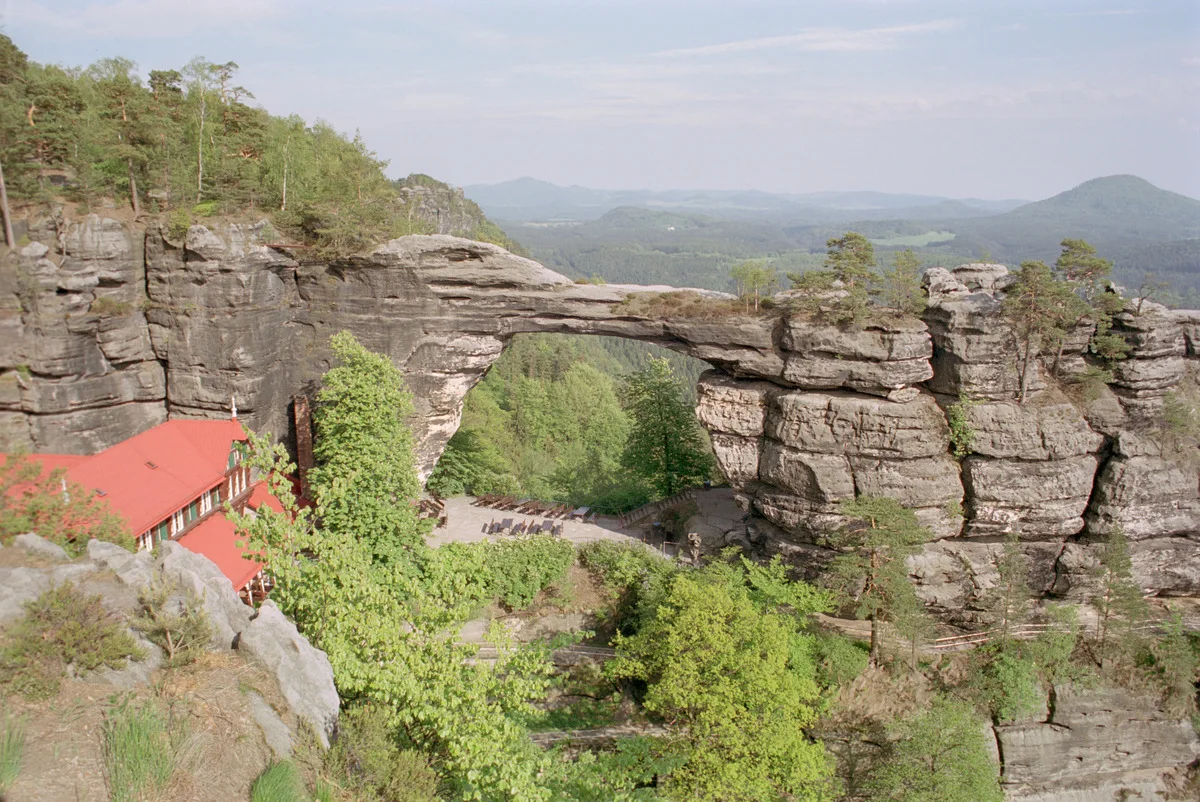
The best-known places lie on either side. The Bastei bridge in Saxon Switzerland runs between rock pillars and is the image the area is known by. The Pravčická brána in Bohemian Switzerland is a natural sandstone arch, formed when erosion ate away beneath a connection while the top stayed put.
What Switzerland has to do with it
Both parks carry the name Switzerland, and there is not a single Swiss mountain in sight.
That name dates from a time when Switzerland was the yardstick for mountainous landscape, and when promoting a region as the Switzerland of somewhere was commonplace. More names of that kind have stuck around Europe.
What stands here is in fact the opposite of an Alpine landscape. There was no ice scouring valleys and there are no thrust-up rock layers. This is a flat pack of marine deposit that water has worked its way through, and that explains why the rocks here stand upright rather than tilted.