The Prague clock: where twenty-four means sunset
On the Old Town Square hangs a clock that counts time in several ways at once. One of those ways has to shift with the seasons.
Most people standing in front of the Orloj are waiting for the hourly show. In doing so they miss the most interesting part: that this device does not show one time but several, and that one of them sits differently every day.
How old it really is
The oldest part, the clock mechanism itself and the astronomical dial, dates from 1410. It was made by the horologist Mikuláš of Kadaň, together with Jan Šindel, professor of mathematics and astronomy at Charles University.
That those two names stand together is precisely the point. This is not a clock devised by a craftsman and approved by a scholar; it is an instrument in which astronomy and fine mechanics were designed together from the start.
The first recorded mention is dated 9 October 1410. Around 1490 a calendar dial was added and the facade was decorated in Gothic forms.
The twenty-four that does not stay put
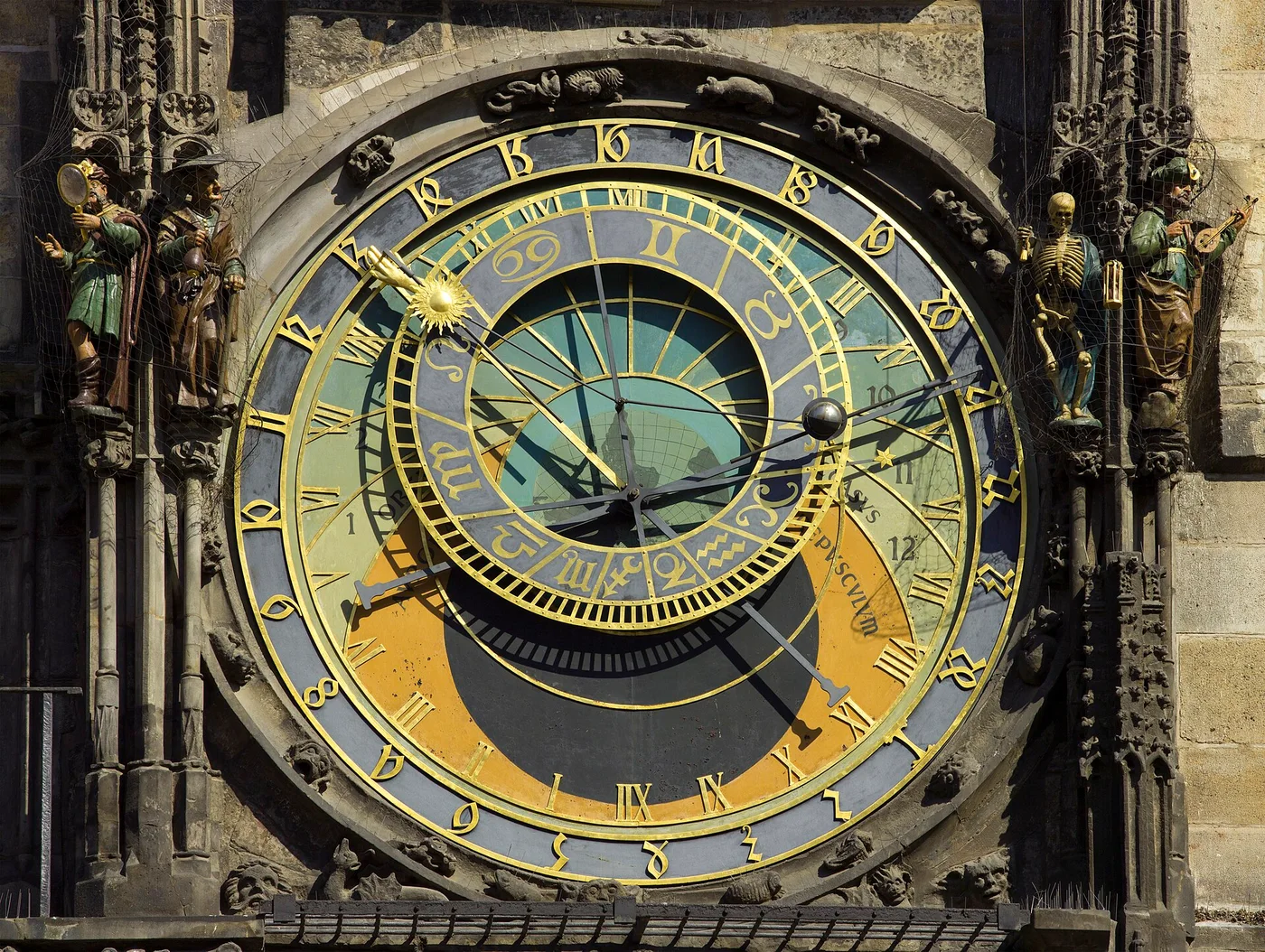
Around the outer edge of the dial are golden numerals in Schwabacher type on a black ground. They indicate Old Czech time, also called Italian hours.
In that reckoning the day does not begin at midnight, nor at sunrise, but at sunset. The figure 24 therefore marks the moment the sun goes down.
And there lies the difficulty. Sunset is not the same every day. In summer it falls hours later than in winter. A dial on which 24 marks sunset is therefore correct on only one day of the year, unless the whole ring is shifted with the seasons. That is exactly what happens: that outer ring of numerals has to be adjusted.
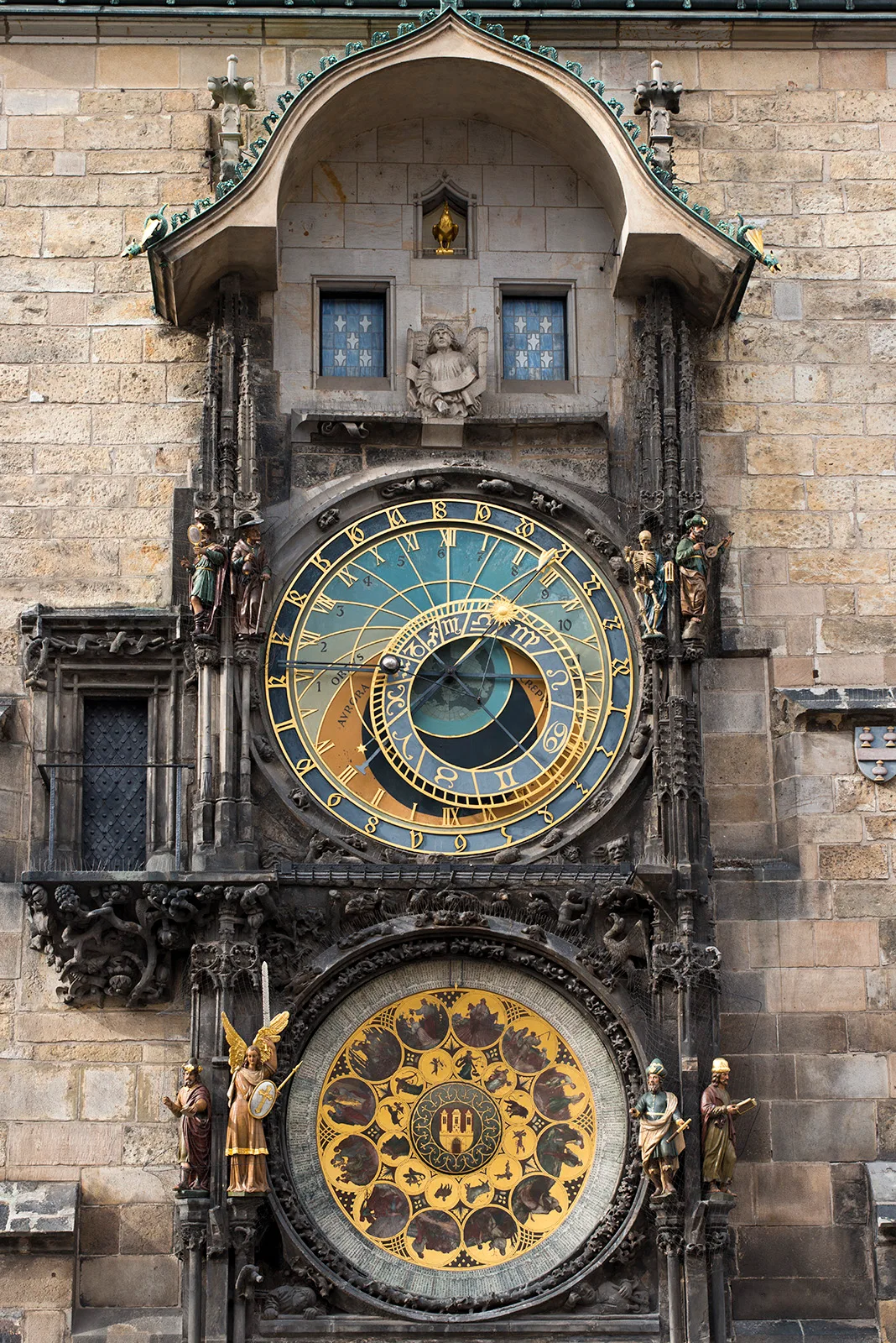
It is a notion of time that feels strange to us and was entirely logical for a city without street lighting. What you wanted to know was not what the hour was but how much daylight you had left.
Gears that rebuild the sky
Inside sits the translation of all those motions into metal. The zodiac turns on a gear with three hundred and sixty-five teeth, one for each day of the year. That gear is connected to the Sun gear and the Moon gear through a gear with twenty-four teeth.
From those ratios the rest follows: where the sun stands against the zodiac, what phase the moon is in, which day of the year it is. It is not a picture of the sky but a mechanical model of it, keeping itself up to date for as long as it runs.
The legend, and what is true of it
A story is told about the clock in various forms, in which the maker is blinded after completion so that he can never build anything comparable, and in which the only hope of repair is a boy born on New Year's night.
The story is attractive and it does not fit what we know about the makers. Mikuláš of Kadaň and Jan Šindel are known by name, with their trade and their university attached. That a legend has gathered around a clock more than six centuries old says something else: faced with something they do not understand, people would rather tell a story about revenge than one about gearing.
Anyone standing before the Orloj is therefore looking at two things at once. An instrument that computes the positions of sun and moon with fifteenth-century gears. And a set of stories that grew around it because those gears stay invisible to most passers-by.